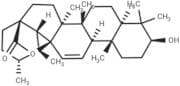
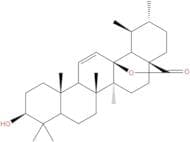
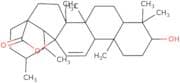
CAS 35959-05-8
:3-Hydroxy-11-ursen-28,13-olide
Description:
3-Hydroxy-11-ursen-28,13-olide, with the CAS number 35959-05-8, is a naturally occurring triterpenoid compound primarily derived from various plant sources. This substance is characterized by its complex molecular structure, which includes a hydroxyl group and a lactone functional group, contributing to its biological activity. Triterpenoids like this one are known for their diverse pharmacological properties, including anti-inflammatory, antioxidant, and potential anticancer effects. The presence of the hydroxyl group enhances its solubility in polar solvents, while the lactone structure may influence its reactivity and interaction with biological targets. Additionally, compounds of this class often exhibit a range of biological activities, making them of interest in medicinal chemistry and natural product research. The specific stereochemistry and arrangement of functional groups in 3-Hydroxy-11-ursen-28,13-olide play a crucial role in determining its biological efficacy and potential therapeutic applications. Further studies are often required to fully elucidate its mechanisms of action and potential uses in pharmacology.
Formula:C30H47O3
Synonyms:- 3β-Hydroxyurs-11-en-28,13-olide
- Ehretiolide
- 3-Hydroxy-11-ursen-28,13-olide
- Ehretiolide/3-Hydroxy-11-ursen-2813-olide
- 13-olide
- 3beta-Hydroxy-urs-11-en 28,13-lactone
- 3β-Hydroxyurs-11-en-28,13β-olide
- 3-Hydroxy-11-ursen-28
Sort by
Purity (%)
0
100
|
0
|
50
|
90
|
95
|
100
Found 4 products.
3-Hydroxy-11-ursen-28,13-olide
CAS:3β-Hydroxy-urs-11-en-28,13β-olide: strong liver cell protection; beats silymarin vs. CCl4 damage; weakly fights ovarian cancer cells.Formula:C30H46O3Purity:98%Color and Shape:SolidMolecular weight:454.6953β-Hydroxyurs-11-en-28,13-olide
CAS:Formula:C30H46O3Purity:95%~99%Color and Shape:PowderMolecular weight:454.6953-Hydroxy-11-ursen-28,13-olide
CAS:3-Hydroxy-11-ursen-28,13-olide is a pentacyclic triterpenoid lactone, which is isolated from various plant sources, predominantly belonging to the family Lamiaceae. This compound acts primarily through modulation of inflammatory pathways, whereby it inhibits key enzymes and signaling molecules involved in inflammatory responses, such as cyclooxygenase and nuclear factor kappa-light-chain-enhancer of activated B cells (NF-κB). Additionally, it has been noted for inducing apoptosis in cancer cells by activating caspases and inhibiting survival pathways.
Formula:C30H46O3Purity:Min. 95%Molecular weight:454.7 g/molRef: 3D-KBA95905
Discontinued product