CymitQuimica logo

CAS 35974-37-9

:

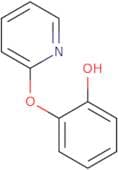
2-(2-Pyridinyloxy)phenol

Description:
2-(2-Pyridinyloxy)phenol, with the CAS number 35974-37-9, is an organic compound characterized by its phenolic structure substituted with a pyridine ring. This compound typically exhibits properties associated with both phenols and heterocyclic compounds. It is a white to off-white solid at room temperature and is soluble in organic solvents, which is common for many phenolic compounds. The presence of the pyridine moiety contributes to its potential as a ligand in coordination chemistry, as it can interact with metal ions. Additionally, the hydroxyl group in the phenolic part can participate in hydrogen bonding, influencing its reactivity and solubility. This compound may also exhibit biological activity, making it of interest in medicinal chemistry and materials science. Its unique structure allows for various applications, including use in the synthesis of more complex molecules or as a building block in organic synthesis. Safety data should be consulted for handling and storage, as with all chemical substances.
Formula:C11H9NO2
InChI:InChI=1/C11H9NO2/c13-9-5-1-2-6-10(9)14-11-7-3-4-8-12-11/h1-8,13H
InChI key:InChIKey=XWBHCJMXMDVYLP-UHFFFAOYSA-N
SMILES:O(C1=C(O)C=CC=C1)C2=CC=CC=N2
Synonyms:
  • 2-(2-Pyridinyloxy)phenol
  • 2-(Pyridin-2-Yloxy)Phenol
  • Phenol, 2-(2-pyridinyloxy)-
  • o-(2-Pyridyloxy)phenol
Sort by

Purity (%)
0
100
|
0
|
50
|
90
|
95
|
100
Found 1 products.
  • o-(2-Pyridyloxy)phenol

    CAS:
    <p>o-(2-Pyridyloxy)phenol is a nitro compound that contains a nitrogen atom and an oxygen atom. It has two isomers, which are designated as 1-nitro-2-pyridyloxybenzene and 2-nitro-1-pyridyloxybenzene. The 1-isomer is more stable than the 2-isomer, but both forms can be synthesized. The 1 form can be obtained by reacting pyridine with nitric acid and anhydrous potassium carbonate at temperatures of 120 degrees Celsius. The 2 isomer can be obtained by reacting pyridine with nitric acid, anhydrous potassium carbonate, and fluorine at temperatures of 190 degrees Celsius. Nitrogen atoms in the molecule can bind to metal ions such as copper or zinc to form complexes. These metal complexes have been shown to exhibit antiinflammatory activity in vitro against Pai-1 cells (a human monocytic cell</p>
    Formula:C11H9NO2
    Purity:Min. 95%
    Molecular weight:187.19 g/mol

    Ref: 3D-KBA97437

    5g
    1,247.00€
    500mg
    478.00€