CAS 36112-95-5
:Propranolol glycol
Description:
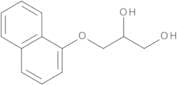
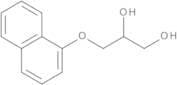
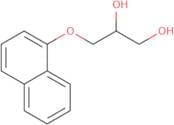
Propranolol glycol, identified by its CAS number 36112-95-5, is a derivative of propranolol, a non-selective beta-adrenergic antagonist commonly used to treat various cardiovascular conditions, anxiety, and migraine prophylaxis. This compound is characterized by its ability to inhibit the action of catecholamines on beta receptors, leading to effects such as decreased heart rate and blood pressure. Propranolol glycol is typically a white to off-white crystalline powder, exhibiting moderate solubility in water and organic solvents, which facilitates its formulation in pharmaceutical preparations. The substance may also possess a range of pharmacokinetic properties, including absorption, distribution, metabolism, and excretion, similar to its parent compound, propranolol. Its safety profile and potential side effects are generally aligned with those of propranolol, necessitating careful consideration in clinical use. As with any pharmaceutical compound, proper handling and storage conditions are essential to maintain its stability and efficacy.
Formula:C13H14O3
InChI:InChI=1/C13H14O3/c14-8-11(15)9-16-13-7-3-5-10-4-1-2-6-12(10)13/h1-7,11,14-15H,8-9H2
InChI key:InChIKey=BYNNMWGWFIGTIC-UHFFFAOYSA-N
SMILES:O(CC(CO)O)C=1C2=C(C=CC1)C=CC=C2
Synonyms:- 1,2-Propanediol, 3-(1-naphthalenyloxy)-
- 1,2-Propanediol, 3-(1-naphthyloxy)-
- 1-(α-Naphthoxy)-2,3-propylene glycol
- 3-(1-Naphthalenyloxy)-1,2-propanediol
- 3-(1-Naphthyloxy)propane-1,2-diol
- 3-(α-Naphthoxy)-1,2-propanediol
- 3-(α-Naphthoxy)-1,2-propylene glycol
- Propranolol glycol
- 3-(naphthalen-1-yloxy)propane-1,2-diol
- Propanolol glycol
- 3-(1-Naphtyloxy)propane-1,2-diol
- Propranolol Hydrochloride EP Impurity A
- Propranolol iMpurity A, diol derivative
- 1,2-Dihydroxy-3-(1-naphthoxy)propane
- 3-(1-Naphthyloxy)-1,2-propanediol
- Propranolol Impurity A
- Propranolol EP Impurity A (Propranolol Diol Derivative)
- (2RS)-3-(Naphthalen-1-yloxy)propane
- Propranolol EP impurity A
- Propranolol HCl impurity A
- Propranolol-1
- See more synonyms
Sort by
Purity (%)
0
100
|
0
|
50
|
90
|
95
|
100
Found 7 products.
Propranolol Related Compound A (3-(Naphthalen-1-yloxy)propane-1,2-diol)
CAS:Ether-alcohols and their halogenated, sulfonated, nitrated or nitrosated derivatives not elsewhere specified or includedFormula:C13H14O3Color and Shape:White PowderMolecular weight:218.09429Propranolol EP Impurity A (Propranolol USP Related Compound A, Propranolol Diol Derivative)
CAS:Formula:C13H14O3Color and Shape:Off-White SolidMolecular weight:218.25(2RS)-3-(Naphthalen-1-yloxy)propane-1,2-diol (Diol Derivative)
CAS:Controlled ProductFormula:C13H14O3Color and Shape:NeatMolecular weight:218.253-(1-Naphthalenyloxy)-1,2-propanediol
CAS:Controlled ProductApplications 3-(1-Naphthalenyloxy)-1,2-propanediol is an impurity of Propranolol (P831800), an β−Adrenergic blocker used as a antihypertensive and antilanginal agent.
Not a dangerous good if item is equal to or less than 1g/ml and there is less than 100g/ml in the package
References Semple, H.A., et al.: Drug. Metabolism. Dispost., 23, 794 (1995); Liedholm, H., et al.: Euro. J. Clin. Pharmacol., 38, 469 (1990);Formula:C13H14O3Color and Shape:WhiteMolecular weight:218.25Propranolol glycol
CAS:Propranolol is a beta-adrenergic receptor antagonist that blocks the binding of epinephrine (adrenaline) or norepinephrine to these receptors. It is used in the treatment of hypertension, angina, and other cardiac disorders. Propranolol hydrolyzes in vivo to produce its active form, propranolol glycol. The enzyme responsible for this hydrolysis is unknown. It has been shown that propranolol glycol can be detected in urine samples after oral administration as well as by fluorescence detection methods. Propranolol glycol has been found to be an effective inhibitor of carboxypeptidase A2, an enzyme involved in the metabolism of drugs such as morphine and cephalosporin C. Propranolol Glycol is a beta-adrenergic receptor antagonist that blocks the binding of epinephrine (adrenaline) or norepinephrine to these receptors. It is used inFormula:C13H14O3Purity:Min. 95%Molecular weight:218.25 g/mol