CAS 36131-43-8
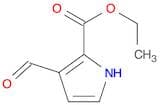
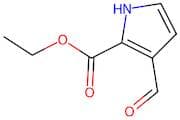
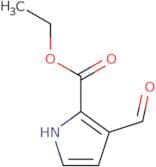
:Ethyl 3-formyl-1H-pyrrole-2-carboxylate
Description:
Ethyl 3-formyl-1H-pyrrole-2-carboxylate is an organic compound characterized by its pyrrole ring structure, which is a five-membered aromatic heterocycle containing nitrogen. This compound features a formyl group (-CHO) and an ethyl ester group (-COOEt) attached to the pyrrole ring, contributing to its reactivity and potential applications in organic synthesis. It typically appears as a colorless to pale yellow liquid or solid, depending on its purity and form. The presence of the formyl group makes it a versatile intermediate for further chemical transformations, such as condensation reactions or cycloadditions. Ethyl 3-formyl-1H-pyrrole-2-carboxylate is of interest in medicinal chemistry and materials science due to its potential biological activity and ability to form various derivatives. Its synthesis often involves the reaction of pyrrole derivatives with appropriate aldehydes and carboxylic acids or their derivatives. As with many organic compounds, handling should be done with care, considering safety protocols to avoid exposure to harmful effects.
Formula:C8H9NO3
Synonyms:- 3-Formylpyrrole-2-Carboxylic Acid Ethyl Ester
Sort by
Purity (%)
0
100
|
0
|
50
|
90
|
95
|
100
Found 4 products.
Ethyl 3-formyl-1H-pyrrole-2-carboxylate
CAS:Formula:C8H9NO3Purity:98%Color and Shape:SolidMolecular weight:167.1620Ethyl 3-formyl-1H-pyrrole-2-carboxylate
CAS:Ethyl 3-formyl-1H-pyrrole-2-carboxylatePurity:98%Molecular weight:167.16g/molEthyl 3-formyl-1H-pyrrole-2-carboxylate
CAS:Formula:C8H9NO3Purity:98%Color and Shape:SolidMolecular weight:167.164ethyl 3-formyl-1H-pyrrole-2-carboxylate
CAS:Ethyl 3-formyl-1H-pyrrole-2-carboxylate is a formyl compound with the molecular formula C8H8O3. It is a colorless liquid that has a strong odor. The compound can be obtained by the reaction of ethyl acetoacetate and pyrrole in the presence of aluminum chloride. The compound has been studied for its nuclear magnetic resonance (NMR) properties. It has two conformers, which are distinguished by their different chemical shifts, and this difference can be used to study coupling between the carbonyl group and other groups in the molecule.
Formula:C8H9NO3Purity:Min. 95%Molecular weight:167.2 g/mol