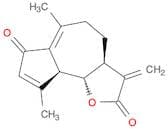
CAS 36150-07-9
:Dehydroleucodine
Description:
Dehydroleucodine is a naturally occurring alkaloid primarily derived from the plant species of the genus *Leucaena*. It is characterized by its complex molecular structure, which includes a bicyclic framework. This compound exhibits a range of biological activities, including potential anti-inflammatory and analgesic properties, making it of interest in pharmacological research. Dehydroleucodine has been studied for its effects on various biological systems, including its interaction with neurotransmitter receptors. Its chemical properties include solubility in organic solvents, which is typical for many alkaloids, and it may exhibit varying degrees of stability under different environmental conditions. The compound's CAS number, 36150-07-9, is a unique identifier that facilitates its recognition in chemical databases and literature. As research continues, the potential therapeutic applications of dehydroleucodine may expand, highlighting the importance of natural products in drug discovery and development.
Formula:C15H16O3
InChI:InChI=1S/C15H16O3/c1-7-4-5-10-9(3)15(17)18-14(10)13-8(2)6-11(16)12(7)13/h6,10,13-14H,3-5H2,1-2H3/t10-,13-,14-/m0/s1
InChI key:InChIKey=SKNVIAFTENCNGB-BPNCWPANSA-N
SMILES:CC=1[C@@]2([C@@]3([C@](C(=C)C(=O)O3)(CCC(C)=C2C(=O)C1)[H])[H])[H]
Synonyms:- (3aS,9aS,9bS)-3,3a,4,5,9a,9b-Hexahydro-6,9-dimethyl-3-methyleneazuleno[4,5-b]furan-2,7-dione
- 11,13-Dehydroleucodin
- Azuleno[4,5-b]furan-2,7-dione, 3,3a,4,5,9a,9b-hexahydro-6,9-dimethyl-3-methylene-, [3aS-(3aα,9aα,9bβ)]-
- Dehydroleucodin
- Dehydroleucodine
- Leucodin, dehydro-
- Lidbeckialactone
- Mesatlantin E
- NSC 180034
- azuleno[4,5-b]furan-2,7-dione, 3,3a,4,5,9a,9b-hexahydro-6,9-dimethyl-3-methylene-, (3aS,9aS,9bS)-
Sort by
Purity (%)
0
100
|
0
|
50
|
90
|
95
|
100
Found 3 products.
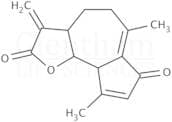
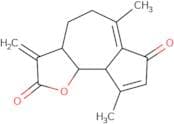
Dehydroleucodine
CAS:Dehydroleucodine is a natural compound that has been shown to have anti-inflammatory and antimicrobial properties. It inhibits the growth of certain bacteria, including Pseudomonas aeruginosa strains, by preventing their ability to synthesize proteins vital for cell division. Dehydroleucodine also induces apoptosis in muscle cells, leading to increased muscle cell proliferation. This compound has been shown to be effective in vitro against 3t3-L1 preadipocytes and leukemic cells in a number of studies. Dehydroleucodine is also an apoptosis protein that regulates the meiosis process by controlling the timing of meiotic entry. In addition, this compound has been shown to promote fetal bovine development by regulating sesquiterpene lactone metabolism and cytosolic Ca2+ levels.Formula:C15H16O3Purity:Min. 95%Molecular weight:244.29 g/mol