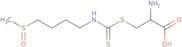
CAS 364083-21-6
:2-amino-3-(4-methylsulfinylbutylcarbamothioylsulfanyl)propanoic acid
D,L-Sulforaphane-L-cysteine
CAS:Controlled ProductFormula:C9H18N2O3S3Color and Shape:Light BrownMolecular weight:298.45S-(N-Methylsulfinylbutylthiocarbamoyl)-L-cysteine
CAS:S-(N-Methylsulfinylbutylthiocarbamoyl)-L-cysteine (SFN-Cys) is an isothiocyanate derivative, functioning as an active metabolite of sulforaphane, a class I andFormula:C9H18N2O3S3Color and Shape:SolidMolecular weight:298.45D,L-Sulforaphane-L-cysteine
CAS:Sulforaphane is a natural compound found in cruciferous vegetables, such as broccoli, cabbage and cauliflower. It has been shown to inhibit the growth of cancer cells and induce apoptosis in prostate cancer cells. Sulforaphane also induces molecular responses that can be measured in assays, including a decrease in protein expression of cyclin-dependent kinase 2 (CDK2) and an increase in the expression of p21. Sulforaphane has been shown to inhibit cell proliferation by blocking the phosphorylation of retinoblastoma protein (pRB) and reducing the levels of cyclins A2/B1. The optimum concentration for sulforaphane is not yet known, but it has been shown to be more effective at lower concentrations. Sulforaphane has also been shown to reduce tumor size and number in bovine fetuses exposed to carcinogens during gestation. In addition, sulforaphane decreased the incidence of tumors when administered before
Formula:C9H18N2O3S3Purity:Min. 95%Color and Shape:PowderMolecular weight:298.45 g/molRef: 3D-FS27963
Discontinued product