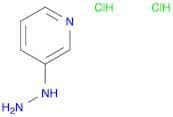
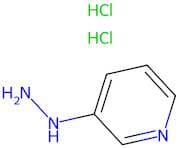
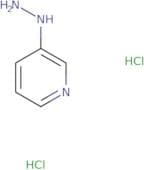
CAS 364727-74-2
:3-Hydrazinopyridine
Description:
3-Hydrazinopyridine is an organic compound characterized by the presence of a hydrazine functional group (-NH-NH2) attached to a pyridine ring. This compound typically appears as a colorless to light yellow solid and is soluble in polar solvents such as water and alcohols. Its molecular structure allows for potential applications in medicinal chemistry, particularly as a building block for the synthesis of various pharmaceuticals and agrochemicals. The hydrazine moiety can participate in various chemical reactions, including condensation and oxidation, making it a versatile intermediate in organic synthesis. Additionally, 3-Hydrazinopyridine may exhibit biological activity, which can be explored for potential therapeutic uses. However, handling this compound requires caution due to the toxicity associated with hydrazine derivatives. As with many nitrogen-containing heterocycles, it may also display interesting electronic properties, making it a subject of study in materials science and coordination chemistry. Overall, 3-Hydrazinopyridine is a significant compound in both synthetic and applied chemistry contexts.
Formula:C5H7N3ClH
Synonyms:- Pyridine, 3-Hydrazinyl-
- 3-Hydrazinylpyridine
- 3-Hydrazino-pyridine
Sort by
Purity (%)
0
100
|
0
|
50
|
90
|
95
|
100
Found 4 products.
3-Hydrazinopyridine DiHCl
CAS:Formula:C5H9Cl2N3Purity:97%Color and Shape:SolidMolecular weight:182.05113-Hydrazinylpyridine dihydrochloride
CAS:3-Hydrazinylpyridine dihydrochlorideFormula:C5H7N3·2ClHPurity:97%Color and Shape: yellow solidMolecular weight:182.05106g/mol3-Hydrazinopyridine dihydrochloride
CAS:Formula:C5H9Cl2N3Purity:97%Color and Shape:SolidMolecular weight:182.053-Hydrazinopyridine 2HCl
CAS:3-Hydrazinopyridine 2HCl is a carboxylic acid that occurs naturally in the form of its dihydrochloride salt, 3-hydrazinopyridine dihydrochloride. It is an intermediate in the synthesis of numerous other compounds and has been used as a precursor to maleic anhydride. 3-Hydrazinopyridine 2HCl is also a reagent for the production of dialkylated or chlorinated derivatives. The hydrolysis of 3-hydrazinopyridine 2HCl with sodium hydroxide yields acetic acid, which can be oxidized to form maleic acid, or reduced to form acrylonitrile.Formula:C5H9Cl2N3Purity:Min. 95%Color and Shape:PowderMolecular weight:182.05 g/mol