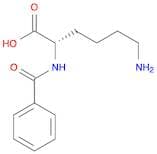
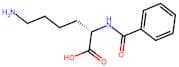
CAS 366-74-5
:Bz-Lys-OH
Description:
Bz-Lys-OH, also known as Benzoyl-Lysine, is an amino acid derivative characterized by the presence of a benzoyl group attached to the amino acid lysine. This compound is typically utilized in biochemical research and peptide synthesis due to its ability to serve as a building block for more complex molecules. The benzoyl group enhances the lipophilicity of lysine, which can influence the solubility and reactivity of the compound in various chemical environments. Bz-Lys-OH is generally white to off-white in appearance and is soluble in organic solvents, while its solubility in water may be limited. The compound can participate in various chemical reactions, including acylation and coupling reactions, making it valuable in the synthesis of peptides and other bioactive molecules. Additionally, it may exhibit specific biological activities, although its primary use remains in synthetic applications. Proper handling and storage conditions are essential to maintain its stability and integrity in laboratory settings.
Formula:C13H18N2O3
InChI:InChI=1/C13H18N2O3/c14-9-5-4-8-11(13(17)18)15-12(16)10-6-2-1-3-7-10/h1-3,6-7,11H,4-5,8-9,14H2,(H,15,16)(H,17,18)
SMILES:c1ccc(cc1)C(=NC(CCCCN)C(=O)O)O
Synonyms:- N~2~-benzoyllysine
Sort by
Purity (%)
0
100
|
0
|
50
|
90
|
95
|
100
Found 4 products.
(S)-6-Amino-2-benzamidohexanoic acid
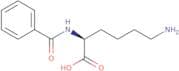
CAS:(S)-6-Amino-2-benzamidohexanoic acidPurity:98%Molecular weight:250.3g/molN-alpha-Benzoyl-L-lysine
CAS:N-alpha-Benzoyl-L-lysine is a lysine analogue that has been shown to have anaphylactic effects in pigs. This compound is synthesized by reacting the benzoyl chloride with L-lysine. The reaction scheme for this synthesis can be found in Figure 1 below. In order to produce this product, it is necessary to first dissolve the reactants in a solvent such as dichloromethane or chloroform. The solvents are then removed by evaporation and the residue obtained is purified by recrystallization or chromatography. N-alpha-Benzoyl-L-lysine has also been shown to be able to elicit formyl amides from plant cells, which may lead to new insights into how plants respond to environmental cues.Formula:C13H18N2O3Purity:Min. 95%Molecular weight:250.29 g/mol