CAS 36887-98-6
:5-Quinolinamine,1,2,3,4-tetrahydro-
Description:
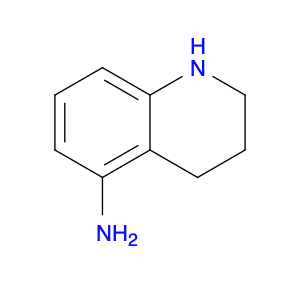
5-Quinolinamine, 1,2,3,4-tetrahydro- is an organic compound characterized by its bicyclic structure, which includes a quinoline moiety and a tetrahydro configuration. This compound features a nitrogen atom within the quinoline ring, contributing to its basicity and potential for forming hydrogen bonds. It is typically a colorless to pale yellow solid, and its solubility can vary depending on the solvent, often being more soluble in polar organic solvents. The presence of the tetrahydro group indicates that it has undergone partial hydrogenation, which can influence its reactivity and biological activity. This compound may exhibit various pharmacological properties, making it of interest in medicinal chemistry. Its CAS number, 36887-98-6, is a unique identifier that facilitates the search for information regarding its synthesis, applications, and safety data. As with many nitrogen-containing heterocycles, it may also participate in diverse chemical reactions, including electrophilic substitutions and nucleophilic attacks, which are essential for further functionalization in synthetic organic chemistry.
Formula:C9H12N2
Synonyms:- 5-Amino-1,2,3,4-tetrahydroquinoline
Sort by
Purity (%)
0
100
|
0
|
50
|
90
|
95
|
100
Found 4 products.
1,2,3,4-Tetrahydroquinolin-5-amine
CAS:Formula:C9H12N2Purity:98%Color and Shape:SolidMolecular weight:148.20501,2,3,4-Tetrahydroquinolin-5-amine
CAS:1,2,3,4-Tetrahydroquinolin-5-aminePurity:98%Color and Shape:SolidMolecular weight:148.20g/mol1,2,3,4-Tetrahydroquinolin-5-amine
CAS:Formula:C9H12N2Purity:98%Color and Shape:SolidMolecular weight:148.2091,2,3,4-Tetrahydroquinolin-5-amine
CAS:1,2,3,4-Tetrahydroquinolin-5-amine (1,2,3,4-THQ) is a hydrazine derivative that has been used in organic synthesis as a reagent for the reductive amination of amines. It is also used as a precursor for the synthesis of other heteroaromatic compounds. The 1,2,3,4-THQ can be prepared by condensation of aniline with nitroethane and phenylenediamine in the presence of Raney nickel. Analogous reactions have been reported using benzylamine derivatives.
Formula:C9H12N2Purity:Min. 95%Molecular weight:148.2 g/mol