CAS 36926-82-6
:1,2-Dihydro-2-oxo-3-quinolinecarbonitrile
Description:
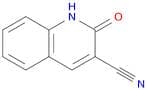
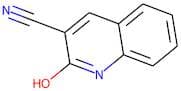
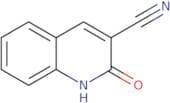
1,2-Dihydro-2-oxo-3-quinolinecarbonitrile, with the CAS number 36926-82-6, is a heterocyclic organic compound characterized by its quinoline structure, which includes a fused bicyclic system containing a nitrogen atom. This compound features a carbonitrile functional group, contributing to its reactivity and potential applications in organic synthesis. It typically appears as a solid at room temperature and is soluble in organic solvents. The presence of both a carbonyl and a nitrile group in its structure suggests that it may exhibit interesting chemical properties, such as the ability to participate in nucleophilic reactions or serve as a building block for more complex molecules. Additionally, compounds of this type may possess biological activity, making them of interest in medicinal chemistry. However, specific physical properties such as melting point, boiling point, and spectral data would need to be referenced from experimental sources for precise applications and safety considerations.
Formula:C10H6N2O
InChI:InChI=1S/C10H6N2O/c11-6-8-5-7-3-1-2-4-9(7)12-10(8)13/h1-5H,(H,12,13)
InChI key:InChIKey=WNRMLIGSXULUPQ-UHFFFAOYSA-N
SMILES:C(#N)C1=CC=2C(NC1=O)=CC=CC2
Synonyms:- 1,2-Dihydro-2-oxo-3-quinolinecarbonitrile
- 2-Hydroxy-3-quinolinecarbonitrile
- 2-Oxo-1H-quinoline-3-carbonitrile
- 3-Cyano-2-quinolone
- 3-Cyanoquinolin-2-one
- 3-Quinolinecarbonitrile, 1,2-dihydro-2-oxo-
- 3-Quinolinecarbonitrile, 2-hydroxy-
Sort by
Purity (%)
0
100
|
0
|
50
|
90
|
95
|
100
Found 3 products.
2-Oxo-1,2-dihydroquinoline-3-carbonitrile
CAS:Formula:C10H6N2OColor and Shape:SolidMolecular weight:170.16742-Oxo-1,2-dihydroquinoline-3-carbonitrile
CAS:2-Oxo-1,2-dihydroquinoline-3-carbonitrilePurity:≥95%Color and Shape:SolidMolecular weight:170.17g/mol2-Oxo-1,2-dihydroquinoline-3-carbonitrile
CAS:2-Oxo-1,2-dihydroquinoline-3-carbonitrile is a chemical compound that is used as an antiallergic agent. It has been shown to inhibit the release of histamine from mast cells and also inhibits the release of prostaglandins from human platelets. The compound is synthesized by condensation of ammonium chloride with nitropropane in the presence of sodium azide. The x-ray analysis shows that this compound has a quinoline ring.
Formula:C10H6N2OPurity:Min. 95%Molecular weight:170.17 g/mol