CAS 36953-41-0
:3-Bromo-4-pyridinol
Description:
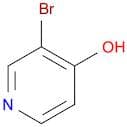
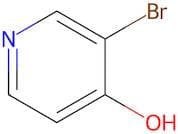
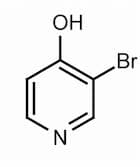
3-Bromo-4-pyridinol is an organic compound characterized by its pyridine ring, which is a six-membered aromatic heterocycle containing one nitrogen atom. The presence of a bromine atom at the 3-position and a hydroxyl group (-OH) at the 4-position distinguishes this compound. It typically appears as a solid or liquid, depending on the specific conditions, and is known for its potential applications in pharmaceuticals and agrochemicals due to its biological activity. The compound exhibits moderate solubility in polar solvents, reflecting the influence of the hydroxyl group, while the bromine substituent can enhance its reactivity in various chemical reactions, such as nucleophilic substitutions. Additionally, 3-bromo-4-pyridinol can participate in hydrogen bonding due to the hydroxyl group, which may affect its interaction with other molecules. Safety data indicates that, like many brominated compounds, it should be handled with care, as it may pose health risks upon exposure. Overall, its unique structure and functional groups contribute to its significance in synthetic chemistry and medicinal applications.
Formula:C5H4BrNO
InChI:InChI=1S/C5H4BrNO/c6-4-3-7-2-1-5(4)8/h1-3H,(H,7,8)
InChI key:InChIKey=JWHZKNRXTDYNJO-UHFFFAOYSA-N
SMILES:BrC=1C(O)=CC=NC1
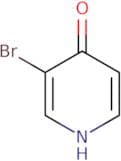
Synonyms:- 3-Bromo-1H-pyridin-4-one
- 3-Bromo-4-pyridinol
- 3-bromopyridin-4(1H)-one
- 4-Pyridinol, 3-bromo-
- 3-Bromo-4-hydroxypyridine
- 3-bromopyridin-4-ol
Sort by
Purity (%)
0
100
|
0
|
50
|
90
|
95
|
100
Found 5 products.
3-Bromo-4-hydroxypyridine
CAS:3-Bromo-4-hydroxypyridineFormula:C5H4BrNOPurity:98%Color and Shape: light yellow powderMolecular weight:174.00g/mol3-Bromopyridin-4-ol
CAS:3-Bromopyridin-4-ol is a pyrrole that can be used as a cancer therapy. It inhibits the growth of cancer cells by binding to the mkn-45 on the surface of the cell, which prevents it from binding to other proteins and initiating cell proliferation. 3-Bromopyridin-4-ol also inhibits 2-amino-4-hydroxypyridine aminations, which are reactions that produce compounds that promote cancer. This compound class has inhibitory activity against the growth of cancer cells in vitro and in vivo. 3-Bromopyridin-4-ol is an oxindole and amide with a hydroxy group on its side chain. It can be synthesized from 3-bromo-5 hydroxypyridine by reacting it with ammonia or methylamine. The synthesis of this compound can be achieved by reacting 2 chloroacetaldehyde with nitroethane in presenceFormula:C5H4BrNOPurity:Min. 95%Color and Shape:PowderMolecular weight:174 g/mol