CAS 370-22-9
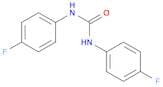
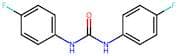
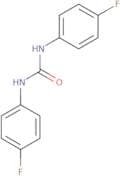
:1,3-bis(4-fluorophenyl)urea
Description:
1,3-bis(4-fluorophenyl)urea, with the CAS number 370-22-9, is an organic compound characterized by its urea functional group and two para-fluorophenyl substituents. This compound typically appears as a white to off-white solid and is known for its relatively high melting point. It is soluble in organic solvents such as dimethyl sulfoxide (DMSO) and dimethylformamide (DMF), but has limited solubility in water. The presence of fluorine atoms in the phenyl rings enhances its lipophilicity and may influence its biological activity, making it of interest in pharmaceutical research. This compound is often studied for its potential applications in medicinal chemistry, particularly in the development of herbicides and other agrochemicals. Its structure allows for various interactions with biological targets, which can be explored for therapeutic purposes. As with many chemical substances, proper handling and safety precautions are essential due to potential toxicity and environmental impact.
Formula:C13H10F2N2O
InChI:InChI=1/C13H10F2N2O/c14-9-1-5-11(6-2-9)16-13(18)17-12-7-3-10(15)4-8-12/h1-8H,(H2,16,17,18)
SMILES:c1cc(ccc1F)NC(=O)Nc1ccc(cc1)F
Synonyms:- urea, N,N'-bis(4-fluorophenyl)-
Sort by
Purity (%)
0
100
|
0
|
50
|
90
|
95
|
100
Found 5 products.
1,3-Bis(4-fluorophenyl)urea
CAS:Formula:C13H10F2N2OPurity:>98.0%(HPLC)(qNMR)Color and Shape:White to Almost white powder to crystalMolecular weight:248.23N,N'-bis(4-fluorophenyl)urea
CAS:Formula:C13H10F2N2OPurity:98%Color and Shape:SolidMolecular weight:248.22811,3-Bis(4-fluorophenyl)urea
CAS:1,3-Bis(4-fluorophenyl)urea is a crystalline solid that is soluble in organic solvents. It has been used as an intermediate in the synthesis of other compounds. 1,3-Bis(4-fluorophenyl)urea is an electron acceptor and can be used to produce diphenyl ethers. This compound has been synthesized using ethyl acetoacetate and anilines. It can be used to treat infectious diseases such as tuberculosis, where it inhibits protein synthesis and cell growth by disrupting the formation of bacterial DNA.
Formula:C13H10F2N2OPurity:Min. 98 Area-%Color and Shape:White Off-White PowderMolecular weight:248.23 g/mol