CAS 37074-90-1
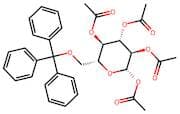
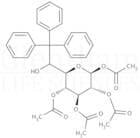
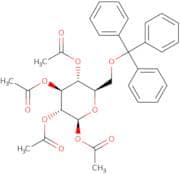
:b-D-Glucopyranose,6-O-(triphenylmethyl)-, 1,2,3,4-tetraacetate
Description:
β-D-Glucopyranose, 6-O-(triphenylmethyl)-, 1,2,3,4-tetraacetate is a derivative of glucose, specifically modified at the 6-position with a triphenylmethyl (trityl) group and acetylated at the hydroxyl groups on the 1, 2, 3, and 4 positions. This compound is characterized by its complex structure, which enhances its stability and solubility in organic solvents. The presence of the trityl group provides steric protection, making it useful in organic synthesis and carbohydrate chemistry. The tetraacetate form indicates that all four hydroxyl groups of the glucose molecule are acetylated, which can influence the compound's reactivity and interactions with other molecules. This modification typically results in increased lipophilicity and altered biological activity compared to the parent sugar. The compound is often utilized in synthetic pathways for the preparation of more complex carbohydrates or as a protective group in glycosylation reactions. Its CAS number, 37074-90-1, allows for easy identification and reference in chemical databases.
Formula:C33H34O10
Synonyms:- b-D-Glucopyranose,6-O-(triphenylmethyl)-, tetraacetate (9CI)
- 1,2,3,4-Tetra-O-acetyl-6-O-triphenylmethyl-b-D-glucopyranose
- Nsc 404268
Sort by
Purity (%)
0
100
|
0
|
50
|
90
|
95
|
100
Found 3 products.
1,2,3,4-Tetra-O-acetyl-6-O-trityl-β-D-glucopyranose
CAS:1,2,3,4-Tetra-O-acetyl-6-O-trityl-β-D-glucopyranosePurity:>98%Molecular weight:590.62g/mol1,2,3,4-Tetra-O-acetyl-6-O-triphenylmethyl-b-D-glucopyranose
CAS:1,2,3,4-Tetra-O-acetyl-6-O-triphenylmethyl-b-D-glucopyranose (TATPG) is a carbohydrate that belongs to the family of saccharides. It is a synthetic sugar with a modified glycosidic linkage between the hexoses 1 and 2. The preparation of TATPG is through the modification of sugar with fluorination and glycosylation. TATPG has been used in Click chemistry to attach polymers and proteins to oligosaccharides or monosaccharides. This modification can be achieved through methylation or substitution reactions with other chemical groups such as acetate, phosphates, and thiols. This molecule has also been used in the synthesis of complex carbohydrates by modifying the glucose unit with glucose oxidase, which leads to the formation of D-arabinitol 1,5-.Formula:C33H34O10Purity:Min. 95%Color and Shape:PowderMolecular weight:590.62 g/mol