CAS 3717-29-1
:Benzaldehyde, 3-nitro-, oxime, (E)-
Description:
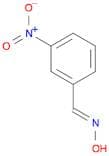
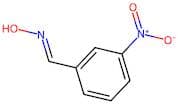
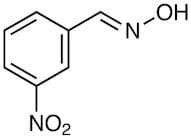
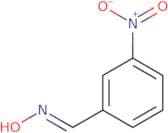
Benzaldehyde, 3-nitro-, oxime, (E)- is an organic compound characterized by the presence of a benzaldehyde moiety with a nitro group and an oxime functional group. Its structure features a phenyl ring attached to a carbonyl group, which is converted into an oxime through the reaction with hydroxylamine. The (E)- designation indicates that the oxime is in the trans configuration, meaning that the substituents on the double bond are on opposite sides. This compound is typically a crystalline solid at room temperature and is known for its aromatic properties due to the benzene ring. It may exhibit moderate solubility in polar solvents and is often used in organic synthesis and as an intermediate in the production of various chemical compounds. The presence of the nitro group can impart additional reactivity, making it a useful building block in the synthesis of pharmaceuticals and agrochemicals. Safety precautions should be taken when handling this compound, as it may pose health risks if ingested or inhaled.
Formula:C7H6N2O3
Sort by
Purity (%)
0
100
|
0
|
50
|
90
|
95
|
100
Found 4 products.
syn-3-Nitrobenzaldoxime
CAS:Formula:C7H6N2O3Purity:98.0%Color and Shape:SolidMolecular weight:166.1341syn-3-Nitrobenzaldoxime
CAS:Formula:C7H6N2O3Purity:>98.0%(GC)Color and Shape:White to Light yellow powder to crystalMolecular weight:166.14syn-3-Nitrobenzaldoxime
CAS:Syn-3-Nitrobenzaldoxime is a molecule that is produced by the reaction of anhydrous sodium and chloride in the presence of aluminium. It is a white solid that has a melting point of -6°C to -8°C. Syn-3-Nitrobenzaldoxime has two possible isomers, syn-3-nitrobenzaldoxime and anti-syn-3-nitrobenzaldoxime. The rate of this reaction increases with temperature, which means it would be more efficient at higher temperatures. Syn-3-Nitrobenzaldoxime can be used for analytical methods such as spectrometric measurements, kinetic analysis, and vibrational spectroscopy. It can also be used in chemical ionization experiments because it will emit positive ions when it decomposes due to its high molecular weight. Syn-3-Nitrobenzaldoxime may also be used in functional theory calculations becauseFormula:C7H6N2O3Purity:Min. 95%Molecular weight:166.14 g/mol