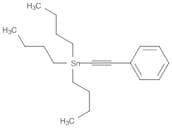
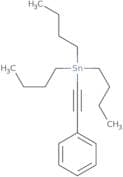
CAS 3757-88-8
:tributyl(phenylethynyl)stannane
Description:
Tributyl(phenylethynyl)stannane, with the CAS number 3757-88-8, is an organotin compound characterized by the presence of a tin atom bonded to three butyl groups and one phenylethynyl group. This compound typically exhibits a colorless to pale yellow appearance and is known for its relatively low volatility. It is soluble in organic solvents, making it useful in various chemical applications. The presence of the phenylethynyl group imparts unique reactivity, particularly in coupling reactions, which can be exploited in organic synthesis and materials science. Organotin compounds like tributyl(phenylethynyl)stannane are often studied for their potential applications in catalysis, as well as in the development of polymers and other advanced materials. However, it is important to note that organotin compounds can pose environmental and health risks, leading to regulatory scrutiny. Proper handling and disposal measures should be observed when working with this substance to mitigate any potential hazards.
Formula:C20H32Sn
InChI:InChI=1/C8H5.3C4H9.Sn/c1-2-8-6-4-3-5-7-8;3*1-3-4-2;/h3-7H;3*1,3-4H2,2H3;/rC20H32Sn/c1-4-7-16-21(17-8-5-2,18-9-6-3)19-15-20-13-11-10-12-14-20/h10-14H,4-9,16-18H2,1-3H3
SMILES:CCCC[Sn](CCCC)(CCCC)C#Cc1ccccc1
Synonyms:- Stannane, tributyl(2-phenylethynyl)-
- Stannane, tributyl(phenylethynyl)-
- Tributyl(phenylethynyl)stannane
Sort by
Purity (%)
0
100
|
0
|
50
|
90
|
95
|
100
Found 3 products.
PHENYLETHYNYLTRI-N-BUTYLTIN
CAS:Formula:C20H32SnPurity:60%Color and Shape:LiquidMolecular weight:391.1691Tributyl(phenylethynyl)tin
CAS:Controlled ProductTributyl(phenylethynyl)tin (TBT) is a palladium complex that is used in the synthesis of organic compounds. TBT is prepared by the reaction of two equivalents of phenylethyne with tributyltin chloride followed by hydrolysis. TBT has been shown to catalyze the cross-coupling reactions between alkynes and aryl bromides, which typically proceed via palladium-catalyzed cross-coupled reactions. Cross-coupling reactions are an important synthetic method for constructing organic molecules from simple starting materials. The reaction rate and kinetics of these transformations can be controlled by changing the substituents on the palladium complex. TBT has also been shown to catalyze ring opening reactions, such as those occurring in nature or can be induced synthetically. This type of reaction is typically carried out using organometallic catalysts such as nickel or copper compounds, but TBT has been foundFormula:C20H32SnPurity:Min. 95%Color and Shape:Clear LiquidMolecular weight:391.18 g/mol