CAS 37614-57-6
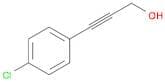
:3-(4-chlorophenyl)prop-2-yn-1-ol
Description:
3-(4-Chlorophenyl)prop-2-yn-1-ol, with the CAS number 37614-57-6, is an organic compound characterized by its alkyne functional group and a hydroxyl group. It features a prop-2-yn-1-ol backbone, which includes a triple bond between the second and third carbon atoms, contributing to its reactivity. The presence of the 4-chlorophenyl group enhances its lipophilicity and may influence its biological activity. This compound is typically a colorless to pale yellow liquid or solid, depending on its purity and specific conditions. It is soluble in organic solvents, such as ethanol and acetone, but has limited solubility in water due to its hydrophobic characteristics. The compound may exhibit various chemical properties, including the ability to participate in nucleophilic reactions due to the presence of the hydroxyl group. Its unique structure makes it of interest in synthetic organic chemistry and potential applications in pharmaceuticals or agrochemicals. Safety precautions should be taken when handling this compound, as it may pose health risks.
Formula:C9H7ClO
InChI:InChI=1/C9H7ClO/c10-9-5-3-8(4-6-9)2-1-7-11/h3-6,11H,7H2
SMILES:C(#Cc1ccc(cc1)Cl)CO
Synonyms:- 2-Propyn-1-ol, 3-(4-chlorophenyl)-
- 3-(4-Chlorophenyl)prop-2-yn-1-ol
- 3-(4-CHLORO-PHENYL)-PROP-2-YN-1-OL
- 3-(4-Chlorophenyl)-2-propyn-1-ol
- AKOS PRN-0003
Sort by
Purity (%)
0
100
|
0
|
50
|
90
|
95
|
100
Found 4 products.
3-(4-Chlorophenyl)prop-2-yn-1-ol
CAS:3-(4-Chlorophenyl)prop-2-yn-1-olPurity:≥95%Color and Shape:SolidMolecular weight:166.60g/mol3-(4-Chloro-phenyl)-prop-2-yn-1-ol
CAS:Formula:C9H7ClOPurity:95%Color and Shape:SolidMolecular weight:166.63-(4-Chloro-phenyl)-prop-2-yn-1-ol
CAS:3-(4-Chloro-phenyl)-prop-2-yn-1-ol is a compound that can be synthesized by the reaction of 3-(4-chlorophenyl)propanal and ammonia. The reaction has been carried out in the presence of ammonium acetate, which acts as a catalyst to promote the formation of this product. This compound may be used for the synthesis of isoquinolines, which are biologically active compounds. The microwave irradiation technique is used for this synthesis to increase yields and decrease time.Formula:C9H7ClOPurity:Min. 95%Molecular weight:166.6 g/mol