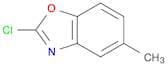
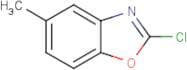
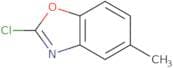
CAS 3770-60-3
:2-chloro-5-methyl-1,3-benzoxazole
Description:
2-Chloro-5-methyl-1,3-benzoxazole is an organic compound characterized by its heterocyclic structure, which includes a benzene ring fused to an oxazole ring. This compound features a chlorine atom and a methyl group attached to the benzoxazole framework, influencing its chemical reactivity and physical properties. It is typically a solid at room temperature and may exhibit moderate solubility in organic solvents, depending on the specific solvent's polarity. The presence of the chlorine atom can impart unique reactivity, making it useful in various chemical syntheses and applications, such as in pharmaceuticals or agrochemicals. The compound may also exhibit biological activity, which is of interest in medicinal chemistry. Its molecular structure contributes to its potential as a building block in the synthesis of more complex molecules. Safety data should be consulted for handling and storage, as halogenated compounds can pose health and environmental risks. Overall, 2-chloro-5-methyl-1,3-benzoxazole is a valuable compound in organic synthesis and research.
Formula:C8H6ClNO
InChI:InChI=1/C8H6ClNO/c1-5-2-3-7-6(4-5)10-8(9)11-7/h2-4H,1H3
SMILES:Cc1ccc2c(c1)nc(Cl)o2
Sort by
Purity (%)
0
100
|
0
|
50
|
90
|
95
|
100
Found 4 products.
2-chloro-5-methyl-1,3-benzoxazole
CAS:Formula:C8H6ClNOPurity:98%Color and Shape:LiquidMolecular weight:167.59232-Chloro-5-methyl-1,3-benzoxazole
CAS:2-Chloro-5-methyl-1,3-benzoxazolePurity:95%Molecular weight:167.59g/mol2-Chloro-5-methyl-1,3-benzoxazole
CAS:2-Chloro-5-methyl-1,3-benzoxazole (CMB) is a regioselective synthetic intermediate that can be used to synthesize other compounds. It is produced by the reaction of chloromethyl methyl ether with anhydrous magnesium chloride in the presence of a solvent such as THF or diethyl ether. CMB can also be prepared by the reaction of 2,4,6-trichlorobenzoyl chloride with magnesium metal and a solvent such as THF or diethyl ether. This intermediate can be used in cross-coupling reactions with Grignard reagents to produce different compounds.Formula:C8H6ClNOPurity:Min. 95 Area-%Color and Shape:PowderMolecular weight:167.59 g/mol