CAS 37827-68-2
:7-Hydroxy-2-tetralone
Description:
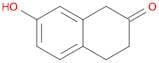
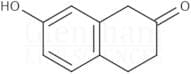
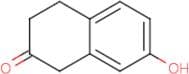
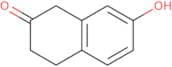
7-Hydroxy-2-tetralone, with the CAS number 37827-68-2, is an organic compound characterized by its bicyclic structure, which consists of a fused benzene and cyclopentane ring. This compound features a hydroxyl group (-OH) at the 7-position and a ketone group (C=O) at the 2-position of the tetralone framework. It is typically a white to off-white crystalline solid, and its solubility can vary depending on the solvent used, often being more soluble in organic solvents than in water. The presence of the hydroxyl group contributes to its potential for hydrogen bonding, influencing its reactivity and interactions with other molecules. 7-Hydroxy-2-tetralone is of interest in various fields, including medicinal chemistry and organic synthesis, due to its potential biological activities and as a precursor for the synthesis of more complex compounds. Its properties, such as melting point, boiling point, and spectral characteristics, can be determined through standard analytical techniques like NMR and IR spectroscopy.
Formula:C10H10O2
InChI:InChI=1/C10H10O2/c11-9-3-1-7-2-4-10(12)6-8(7)5-9/h1,3,5,11H,2,4,6H2
SMILES:c1cc(cc2CC(=O)CCc12)O
Synonyms:- 7-Hydroxy-3,4-dihydronaphthalen-2(1H)-one
Sort by
Purity (%)
0
100
|
0
|
50
|
90
|
95
|
100
Found 5 products.
7-Hydroxy-3,4-dihydro-1H-naphthalen-2-one
CAS:Formula:C10H10O2Purity:97%Color and Shape:SolidMolecular weight:162.18527-Hydroxy-3,4-dihydro-1H-naphthalen-2-one
CAS:Formula:C10H10O2Purity:97%Color and Shape:SolidMolecular weight:162.1887-Hydroxy-3,4-dihydro-1H-naphthalen-2-one
CAS:7-Hydroxy-3,4-dihydro-1H-naphthalen-2-one is an organic solvent that can be used as a pharmaceutical intermediate. It is a white crystalline solid that has been shown to bind to β-cyclodextrin, chloride, and aluminium. 7-Hydroxy-3,4-dihydro-1H-naphthalen-2-one has been shown to form stable complexes with these ions by binding to the oxygens on their surfaces. The binding constants for this compound have been determined using dichromism and fluorescence experiments. This organic solvent has also been found to have enantioselective properties.Formula:C10H10O2Purity:Min. 95%Molecular weight:162.19 g/mol