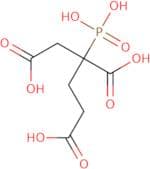
CAS 37971-36-1
:2-Phosphonobutane-1,2,4-tricarboxylic acid
Description:
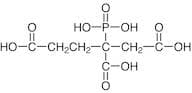
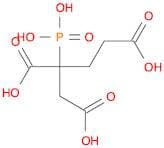
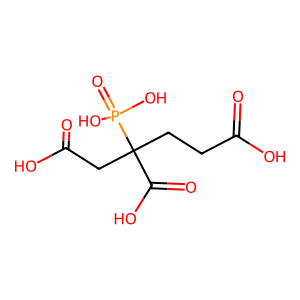
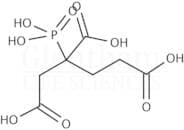
2-Phosphonobutane-1,2,4-tricarboxylic acid, commonly referred to as PBTC, is an organophosphorus compound characterized by its three carboxylic acid groups and a phosphonic acid group. This structure imparts unique properties, making it a versatile chelating agent and scale inhibitor in various industrial applications, particularly in water treatment and oil recovery. PBTC is known for its ability to form stable complexes with metal ions, which helps prevent scale formation in systems where calcium and magnesium ions are prevalent. Additionally, it exhibits good thermal stability and solubility in water, enhancing its effectiveness in aqueous environments. The compound is typically used in formulations to improve the efficiency of detergents and to enhance the performance of corrosion inhibitors. Its environmental profile is generally favorable, as it is biodegradable and less toxic compared to other phosphonates. Overall, 2-Phosphonobutane-1,2,4-tricarboxylic acid is valued for its multifunctional properties in both chemical and industrial applications.
Formula:C7H11O9P
InChI:InChI=1S/C7H11O9P/c8-4(9)1-2-7(6(12)13,3-5(10)11)17(14,15)16/h1-3H2,(H,8,9)(H,10,11)(H,12,13)(H2,14,15,16)
InChI key:InChIKey=SZHQPBJEOCHCKM-UHFFFAOYSA-N
SMILES:C(CCC(O)=O)(CC(O)=O)(P(=O)(O)O)C(O)=O
Synonyms:- 1,2,4-Butanetricarboxylic acid, 2-phosphono-
- 1,2,4-Tricarboxy-sec-butylphosphonic acid
- 2-Phosphonbutane-1,2,4-tricarboxylic acid
- 2-Phosphono butane-1,2,4-tricarboxylic acid
- 2-Phosphono-1,2,4-butanetricarboxylic acid
- 2-Phosphonobutane-1,1,1-Tricarboxylic Acid
- 2-Phosphonobutyl-1,2,4-tricarboxylic acid
- 3-Carboxy-3-phosphonohexanedioic acid
- Bayhibit AM
- Bayhibit AM 50
- Belclene 650
- Chelest PH 430
- Cublen P 50
- Dequest 7000
- Jh 906
- Mayoquest 2100
- Pbdca
- Pbs-Am
- Pbtc
- Pbtca
- Phosphonobutanetricarboxylic acid
- See more synonyms
Sort by
Purity (%)
0
100
|
0
|
50
|
90
|
95
|
100
Found 5 products.
2-Phosphonobutane-1,2,4-tricarboxylic Acid (ca. 50% in Water)
CAS:Formula:C7H11O9PColor and Shape:Colorless to Light yellow clear liquidMolecular weight:270.132-Phosphonobutane-1,2,4-Tricarboxylic Acid
CAS:Formula:C7H11O9PPurity:%Color and Shape:LiquidMolecular weight:270.13062-Phosphonobutane-1,2,4-Tricarboxylic Acid
CAS:2-Phosphonobutane-1,2,4-Tricarboxylic AcidMolecular weight:270.13g/mol2-Phosphonobutane-1,2,4-tricarboxylic acid solution
CAS:Formula:C7H11O9PColor and Shape:Colourless to pale yellow liquidMolecular weight:270.132-Phosphonobutane-1,2,4-tricarboxylic acid, 50% aqueous solution
CAS:Polymerase chain reaction (PCR) is a technique that can be used to amplify a specific segment of DNA. This technique is based on the use of primers, which are short single strands of DNA, to initiate DNA synthesis. The PCR process consists of two steps: 1) an initial denaturation step in which the temperature is raised to 90-95°C for 10 minutes and 2) a series of 30-40 cycles consisting of a sequence of 94°C for 30 seconds, 55°C for 20 seconds, and 72°C for 10 seconds. The optimum concentration for the polymerase chain reaction depends on the type of polymerase enzyme used and the type of nucleotide or base being added. Nitrogen atoms are found in all living organisms and have been shown to be necessary for bacterial growth. When nitrogen atoms are removed from water vapor, it has been shown that bacteria will not grow as well as when there are nitrogen atoms present. Inhibitor molecules such as benzalkFormula:C7H11O9PPurity:Min. 95%Molecular weight:270.13 g/mol