CAS 3801-89-6
:1-(3-Fluorophenyl)piperazine
Description:
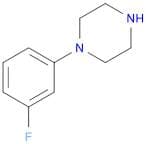
1-(3-Fluorophenyl)piperazine, with the CAS number 3801-89-6, is a chemical compound that belongs to the class of piperazines, which are cyclic organic compounds containing a piperazine ring. This substance features a fluorophenyl group attached to the piperazine, specifically at the 1-position, which influences its chemical properties and biological activity. It is typically a white to off-white solid and is soluble in organic solvents. The presence of the fluorine atom can enhance the compound's lipophilicity and may affect its pharmacological profile. 1-(3-Fluorophenyl)piperazine is of interest in medicinal chemistry and pharmacology, often studied for its potential effects on the central nervous system, including its role as a serotonin receptor modulator. Its structural characteristics allow for various modifications, making it a useful scaffold in drug development. Safety and handling precautions should be observed, as with any chemical substance, due to potential toxicity and reactivity.
Formula:C10H13FN2
InChI:InChI=1S/C10H13FN2/c11-9-2-1-3-10(8-9)13-6-4-12-5-7-13/h1-3,8,12H,4-7H2
InChI key:InChIKey=KIFCSMQTGWVMOD-UHFFFAOYSA-N
SMILES:FC=1C=C(C=CC1)N2CCNCC2
Synonyms:- Piperazine, 1-(3-fluorophenyl)-
- 1-(3-Fluorophenyl)piperazine
- N-(3-Fluorophenyl)piperazine
- 1-(m-Fluorophenyl)piperazine
- Piperazine, 1-(m-fluorophenyl)-
Sort by
Purity (%)
0
100
|
0
|
50
|
90
|
95
|
100
Found 2 products.
Piperazine,1-(3-fluorophenyl)-
CAS:Formula:C10H13FN2Purity:98%Color and Shape:LiquidMolecular weight:180.22201-(3-Fluorophenyl)piperazine
CAS:Controlled Product1-(3-Fluorophenyl)piperazine (3FPP) is a hydrophobic, water-insoluble drug that has been used as an analytical reagent to measure amphetamine and benzylpiperazine in urine. 3FPP binds to the cell membrane and inhibits the uptake of monoamines, such as dopamine, serotonin, and norepinephrine. It also inhibits the metabolic breakdown of these neurotransmitters by inhibiting MAO enzymes and COMT. The anti-cancer effects of 3FPP have been investigated in animal studies using MCF-7 cells. These cells produce large amounts of catecholamines, which are metabolized by COMT into methylated catechols. The inhibition of this enzyme by 3FPP leads to increased levels of catecholamines and increased cytotoxicity for cancer cells.Formula:C10H13FN2Purity:Min. 95%Molecular weight:180.22 g/mol