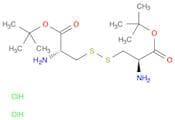
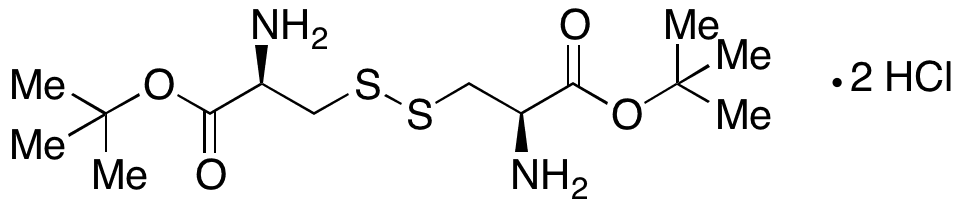
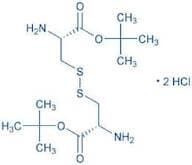
CAS 38261-78-8
:L-Cystine,1,1'-bis(1,1-dimethylethyl) ester, hydrochloride (1:2)
Description:
L-Cystine, 1,1'-bis(1,1-dimethylethyl) ester, hydrochloride (1:2) is a derivative of the amino acid cystine, which is formed by the oxidation of two cysteine molecules. This compound features a bis(1,1-dimethylethyl) ester group, which enhances its lipophilicity and stability. As a hydrochloride salt, it is typically more soluble in water compared to its free base form, facilitating its use in various applications, including pharmaceuticals and biochemistry. The presence of the ester groups may influence its reactivity and bioavailability, making it of interest in drug formulation. L-Cystine itself is known for its role in protein structure and function, particularly in the formation of disulfide bonds that stabilize protein conformation. The compound's characteristics, such as melting point, solubility, and specific reactivity, can vary based on its formulation and purity. Overall, L-Cystine, 1,1'-bis(1,1-dimethylethyl) ester, hydrochloride (1:2) represents a modified amino acid with potential applications in research and therapeutic contexts.
Formula:C14H28N2O4S2・2ClH
Synonyms:- Cystine,di-tert-butyl ester, dihydrochloride
- L-Cystine, bis(1,1-dimethylethyl)ester, dihydrochloride
- L-Cystine di-tert-butyl ester dihydrochloride
- L-Cystine Bis(Tert-Butyl Ester) Dihydrochloride
- (H-Cys-OtBu)2
Sort by
Purity (%)
0
100
|
0
|
50
|
90
|
95
|
100
Found 5 products.
L-Cystine bis(t-butyl ester) DiHCl
CAS:Formula:C14H30Cl2N2O4S2Purity:95%Color and Shape:SolidMolecular weight:425.4350Di-Tert-Butyl (2R,2'R)-3,3'-Disulfanediylbis(2-Aminopropanoate) Dihydrochloride
CAS:Di-Tert-Butyl (2R,2'R)-3,3'-Disulfanediylbis(2-Aminopropanoate) DihydrochloridePurity:95%Molecular weight:425.44g/molL-Cystine Bis(T-butyl Ester) Dihydrochloride
CAS:Controlled ProductApplications L-Cystine Bis(T-butyl Ester) Dihydrochloride is used as a reagent in the synthesis of chelate oxorhenium to create new integrin antagonists.
References Le Gal, J., et al.: J. Inorg. Biochem., 105, 880 (2011);Formula:C14H28N2O4S2Color and Shape:NeatMolecular weight:352.513(2R,2’R)-Di-tert-butyl 3,3′-disulfanediylbis(2-aminopropanoate) dihydrochloride
CAS:Formula:C14H30Cl2N2O4S2Purity:95%Color and Shape:SolidMolecular weight:425.42(H-Cys-OtBu)₂ · 2 HCl
CAS:Bachem ID: 4014989.
Formula:C14H28N2O4S2·2HClPurity:≥ 99%Color and Shape:White PowderMolecular weight:425.44