CAS 383417-46-7
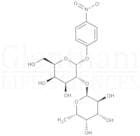
:4-nitrophenyl 2-O-(6-deoxyhexopyranosyl)hexopyranoside
Description:
4-Nitrophenyl 2-O-(6-deoxyhexopyranosyl)hexopyranoside is a glycoside compound characterized by the presence of a nitrophenyl group and a sugar moiety. The structure features a 4-nitrophenyl group, which is known for its electron-withdrawing properties due to the nitro group, enhancing the compound's reactivity in various chemical reactions. The glycosidic bond connects the 2-O position of a hexopyranoside sugar to a 6-deoxyhexopyranosyl unit, indicating that one of the hydroxyl groups on the sugar has been replaced by a hydrogen atom, which can influence the compound's solubility and biological activity. This compound may exhibit properties typical of glycosides, such as being soluble in polar solvents and potentially having applications in biochemical assays or as a substrate for glycosidase enzymes. Its specific reactivity and applications would depend on the context of its use, including potential roles in medicinal chemistry or as a biochemical probe.
Formula:C18H25NO12
InChI:InChI=1/C18H25NO12/c1-7-11(21)13(23)15(25)17(28-7)31-16-14(24)12(22)10(6-20)30-18(16)29-9-4-2-8(3-5-9)19(26)27/h2-5,7,10-18,20-25H,6H2,1H3
SMILES:CC1C(C(C(C(O1)OC1C(C(C(CO)OC1Oc1ccc(cc1)N(=O)=O)O)O)O)O)O
Sort by
Purity (%)
0
100
|
0
|
50
|
90
|
95
|
100
Found 3 products.
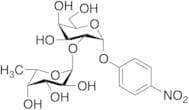
4-Nitrophenyl 2-O-(α-L-Fucopyranosyl)-α-D-galactopyranoside
CAS:Controlled ProductApplications Nitrophenyl derivative of 2-O-(a-L-Fucopyranosyl)-a-D-galactopyranoside (Disaccharide H), a biologically important oligosaccharide component of glycoconjugates that play a role in cellular recognition and intercellular interactions.
References Carbohyd. Res., 4, 189 (1967); Can. J. Chem., 59, 314 (1981); J. Carbohydrate Chem., 11(3), 397 (1992)Formula:C18H25NO12Color and Shape:NeatMolecular weight:447.394-Nitrophenyl 2-O-(a-L-fucopyranosyl)-a-D-galactopyranoside
CAS:4-Nitrophenyl 2-O-(a-L-fucopyranosyl)-a-D-galactopyranoside is a chromogenic pNP enzyme substrate consisting of a fucose and galactose moieties. Upon enzymatic hydrolysis by specific fucosidases or galactosidases, it releases the highly chromogenic molecule 4-nitrophenol, which exhibits a distinct yellow color that can be monitored spectrophotometrically. This substrate is frequently used to study enzyme specificity, kinetics, and inhibition, and it plays a critical role in the investigation of carbohydrate active enzymes (CAZymes), the screening of enzyme inhibitors, and the development of novel analytical methods for the detection and quantitation of enzyme activities.Purity:Min. 95%Molecular weight:447.39 g/mol