CAS 3842-20-4
:(1,3-Dioxo-1,3-dihydro-2H-isoindol-2-yl)acetonitrile
Description:
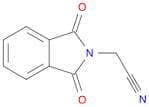
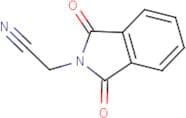
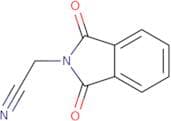
(1,3-Dioxo-1,3-dihydro-2H-isoindol-2-yl)acetonitrile, with the CAS number 3842-20-4, is a chemical compound that features a bicyclic structure characteristic of isoindole derivatives. This compound contains a dioxo group, which contributes to its reactivity and potential applications in organic synthesis. The presence of the acetonitrile functional group indicates that it has a nitrile moiety, which can participate in various chemical reactions, including nucleophilic additions and substitutions. The compound is typically a solid at room temperature and may exhibit moderate solubility in polar organic solvents. Its unique structure may impart specific biological activities, making it of interest in medicinal chemistry and drug development. Additionally, the compound's stability and reactivity can be influenced by the substituents on the isoindole ring, which can affect its interactions in biological systems or its utility in synthetic pathways. As with many organic compounds, safety precautions should be taken when handling it, as it may pose health risks or environmental hazards.
Formula:C10H6N2O2
InChI:InChI=1/C10H6N2O2/c11-5-6-12-9(13)7-3-1-2-4-8(7)10(12)14/h1-4H,6H2
SMILES:c1ccc2c(c1)C(=O)N(CC#N)C2=O
Synonyms:- 2-(1,3-dioxo-2,3-dihydro-1H-isoindol-2-yl)acetonitrile
- 2H-Isoindole-2-acetonitrile, 1,3-dihydro-1,3-dioxo-
- N-Cyanomethyl phthalimide
- 2-(1,3-Dioxoisoindolin-2-Yl)Acetonitrile
Sort by
Purity (%)
0
100
|
0
|
50
|
90
|
95
|
100
Found 4 products.
(1,3-Dioxo-1,3-dihydro-2h-isoindol-2-yl)acetonitrile
CAS:Formula:C10H6N2O2Purity:98%Color and Shape:SolidMolecular weight:186.16682-(1,3-Dioxoisoindolin-2-yl)acetonitrile
CAS:2-(1,3-Dioxoisoindolin-2-yl)acetonitrilePurity:98%Molecular weight:186.17g/mol(1,3-Dioxo-1,3-dihydro-2H-isoindol-2-yl)acetonitrile
CAS:Acetonitrile is a colorless liquid that is miscible with water and most organic solvents. It is mainly used as a solvent for chemical reactions, including the synthesis of pharmaceuticals. Acetonitrile has been shown to be mutagenic in vitro and in vivo. Acetonitrile was found to induce micronuclei formation, which may be due to its ability to form reactive oxygen species or cause DNA damage by forming adducts with DNA bases. Acetonitrile also induced chromosomal aberrations and micronucleated polychromatic erythrocytes in mice, as well as increased reticulocytes (immature red blood cells) in humans. The dihedral angle between the nitrate group and the benzyl group has been found to be 163°, while the average frequency of acetonitrile is 164 Hz.Formula:C10H6N2O2Purity:Min. 95%Color and Shape:PowderMolecular weight:186.17 g/mol