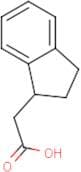
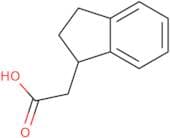
CAS 38425-65-9
:1-Indanylacetic acid
Description:
1-Indanylacetic acid, with the CAS number 38425-65-9, is an organic compound characterized by its indanyl group, which is a bicyclic structure derived from indene, attached to an acetic acid moiety. This compound typically appears as a white to off-white solid and is soluble in organic solvents. It exhibits properties typical of carboxylic acids, including the ability to form hydrogen bonds, which can influence its reactivity and interactions with other molecules. The presence of the indanyl structure may impart unique biological activities, making it of interest in pharmaceutical research. Additionally, its derivatives may exhibit varied pharmacological properties, potentially serving as intermediates in the synthesis of more complex organic compounds. As with many organic acids, it may participate in acid-base reactions and can be involved in esterification processes. Safety data should be consulted for handling and storage, as with any chemical substance, to ensure proper laboratory practices are followed.
Formula:C11H12O2
InChI:InChI=1S/C11H12O2/c12-11(13)7-9-6-5-8-3-1-2-4-10(8)9/h1-4,9H,5-7H2,(H,12,13)
InChI key:InChIKey=RJVZEPWRJJBXLH-UHFFFAOYSA-N
SMILES:C(C(O)=O)C1C=2C(CC1)=CC=CC2
Synonyms:- 1-Indanacetic acid
- 1-Indanaceticacid (7CI)
- 1-Indanylacetic acid
- 1H-Indene-1-acetic acid, 2,3-dihydro-
- 2,3-Dihydro-1H-indene-1-acetic acid
- 2-(2,3-Dihydro-1H-inden-1-yl)acetic acid
- Indane-1-acetic acid
- Nsc 76658
Sort by
Purity (%)
0
100
|
0
|
50
|
90
|
95
|
100
Found 3 products.
2-(2,3-Dihydro-1H-inden-1-yl)acetic acid
CAS:2-(2,3-Dihydro-1H-inden-1-yl)acetic acidFormula:C11H12O2Purity:99%Color and Shape: yellow powderMolecular weight:176.21g/mol2,3-Dihydro-1H-inden-1-ylacetic acid
CAS:Formula:C11H12O2Purity:95.0%Color and Shape:SolidMolecular weight:176.2152-(2,3-Dihydro-1H-inden-1-yl)acetic acid
CAS:2-(2,3-Dihydro-1H-inden-1-yl)acetic acid (DHIAA) is an organic compound that belongs to the group of heterocyclic compounds. It is a plant cell growth regulator and has been shown to inhibit inflammatory diseases in animal models. DHIAA has a stepwise mechanism that starts with the formation of an alkoxy radical by hydrogen bond between the hydroxyl group and the double bond. This mechanism leads to the production of a reactive oxygen species, which causes oxidative damage in cells. DHIAA also inhibits fatty acid synthesis, which may be due to its interaction with peroxisome proliferator-activated receptor alpha (PPAR-α).Formula:C11H12O2Purity:Min. 95%Molecular weight:176.21 g/mol