CAS 38605-65-1
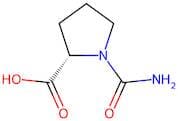
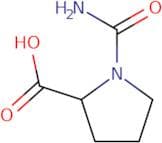
:1-carbamoyl-L-proline
Description:
1-Carbamoyl-L-proline is an amino acid derivative characterized by the presence of a carbamoyl group attached to the proline structure. It is a white crystalline solid that is soluble in water, reflecting its polar nature due to the presence of both the carboxylic acid and amine functional groups. This compound is notable for its role in biochemical processes, particularly in the synthesis of peptides and proteins. The presence of the carbamoyl group can influence the compound's reactivity and interactions with other biomolecules, making it relevant in medicinal chemistry and drug design. Additionally, 1-carbamoyl-L-proline may exhibit specific biological activities, potentially serving as a substrate or inhibitor in enzymatic reactions. Its structural features contribute to its ability to participate in hydrogen bonding and other intermolecular interactions, which are crucial for its function in biological systems. Overall, 1-carbamoyl-L-proline is an important compound in the study of amino acids and their derivatives in both synthetic and natural contexts.
Formula:C6H10N2O3
InChI:InChI=1/C6H10N2O3/c7-6(11)8-3-1-2-4(8)5(9)10/h4H,1-3H2,(H2,7,11)(H,9,10)/t4-/m0/s1
SMILES:C1C[C@@H](C(=O)O)N(C1)C(=N)O
Sort by
Purity (%)
0
100
|
0
|
50
|
90
|
95
|
100
Found 2 products.
(S)-1-Carbamoylpyrrolidine-2-carboxylic acid
CAS:(S)-1-Carbamoylpyrrolidine-2-carboxylic acidPurity:95%Molecular weight:158.16g/mol1-(Aminocarbonyl)-L-proline
CAS:1-(Aminocarbonyl)-L-proline is a molecule that contains an aminocarbonyl group, which is a nucleophilic functional group. It is a cyclic compound with a ring structure consisting of three carbons and two amino groups. The 1-(aminocarbonyl)-L-proline molecule has been studied using Raman spectroscopy, vibrational spectroscopy, X-ray diffraction, and other techniques. This molecule has been shown to have the potential to be used as an anti-cancer drug by inhibiting the synthesis of DNA and RNA in cells. The conformation of this compound may also be important for understanding its reactivity.Formula:C6H10N2O3Purity:Min. 95%Molecular weight:158.16 g/mol