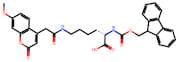
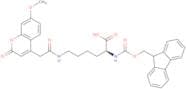
![L-Lysine,N2-[(9H-fluoren-9-ylmethoxy)carbonyl]-N6-[2-(7-methoxy-2-oxo-2H-1-benzopyran-4-yl)acetyl]-](/_next/image/?url=https%3A%2Fstatic.cymitquimica.com%2Fcas-image%2Fthumb-webp%2F339044-l-lysine-n2-9h-fluoren-9-ylmethoxy-carbonyl-n6-2-7-methoxy-2-oxo-2h-1-benzopyran-4-yl-acetyl.webp&w=3840&q=75)
CAS 386213-32-7
:L-Lysine,N2-[(9H-fluoren-9-ylmethoxy)carbonyl]-N6-[2-(7-methoxy-2-oxo-2H-1-benzopyran-4-yl)acetyl]-
Description:
L-Lysine, N2-[(9H-fluoren-9-ylmethoxy)carbonyl]-N6-[2-(7-methoxy-2-oxo-2H-1-benzopyran-4-yl)acetyl]- is a synthetic compound that belongs to the class of amino acids, specifically a derivative of lysine. This compound features a fluorenylmethoxycarbonyl (Fmoc) protecting group, which is commonly used in peptide synthesis to protect the amino group of lysine during chemical reactions. The presence of a benzopyran moiety indicates potential biological activity, as compounds with this structure often exhibit antioxidant properties and may interact with various biological targets. The methoxy and acetyl substituents suggest that the compound may have enhanced solubility and stability. Its molecular structure implies that it could be utilized in pharmaceutical applications, particularly in drug design and development, where modifications to amino acids can lead to improved therapeutic profiles. As with many synthetic compounds, its properties, such as solubility, stability, and reactivity, would depend on the specific conditions under which it is handled and utilized.
Formula:C33H32N2O8
Synonyms:- L-Lysine,N2-[(9H-fluoren-9-ylmethoxy)carbonyl]-N6-[(7-methoxy-2-oxo-2H-1-benzopyran-4-yl)acetyl]-
- Fmoc-Lys(Mca)-Oh
- Bjrf-009-Tm
- (S)-2-(N-(((9H-fluoren-9-yl)methyl9H-fluoren-9-yl)methoxy)carbonyl)acetamido)-6-(7-methoxy-2-oxo-2H-chromen-4-ylamino)hexanoic acid
Sort by
Purity (%)
0
100
|
0
|
50
|
90
|
95
|
100
Found 3 products.
N-alpha-Fmoc-Nepsilon-7-methoxycoumarin-4-acetyl-L-lysine
CAS:N-alpha-Fmoc-Nepsilon-7-methoxycoumarin-4-acetyl-L-lysine is a fluorogenic molecule that is synthesized by the solid phase method. It is an analog of lysine, which is a bioactive amino acid. This compound binds to copper and exhibits fluorescence emission at 585 nm when excited at 488 nm. N-alpha-Fmoc-Nepsilon-7-methoxycoumarin-4-acetyl-L-lysine can be used as a substrate for bone growth in vitro and in vivo. It can also be used as a labeling reagent for bone tissue, such as bone sections or cells. It has been shown to produce osteogenic activity in vitro and in vivo.Formula:C33H32N2O8Purity:Min. 97 Area-%Color and Shape:PowderMolecular weight:584.62 g/mol