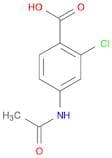
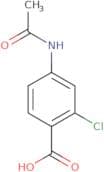
CAS 38667-55-9
:4-(acetylamino)-2-chlorobenzoic acid
Description:
4-(Acetylamino)-2-chlorobenzoic acid, with the CAS number 38667-55-9, is an organic compound characterized by its aromatic structure, which includes a benzoic acid moiety substituted with both an acetylamino group and a chlorine atom. This compound typically appears as a solid and is soluble in polar organic solvents. Its molecular structure features a carboxylic acid functional group, which contributes to its acidic properties, while the acetylamino group enhances its reactivity and potential for forming hydrogen bonds. The presence of the chlorine atom introduces additional polarity and can influence the compound's biological activity. 4-(Acetylamino)-2-chlorobenzoic acid may be utilized in various chemical syntheses and has potential applications in pharmaceuticals, particularly in the development of anti-inflammatory or analgesic agents. As with many organic compounds, handling should be done with care, considering safety data and potential hazards associated with its use.
Formula:C9H8ClNO3
InChI:InChI=1/C9H8ClNO3/c1-5(12)11-6-2-3-7(9(13)14)8(10)4-6/h2-4H,1H3,(H,11,12)(H,13,14)
SMILES:CC(=Nc1ccc(c(c1)Cl)C(=O)O)O
Synonyms:- 4-Acetamido-2-chlorobenzoic acid
- Benzoic Acid, 4-(Acetylamino)-2-Chloro-
Sort by
Purity (%)
0
100
|
0
|
50
|
90
|
95
|
100
Found 2 products.
2-Chloro-4-acetamidobenzoic acid
CAS:2-Chloro-4-acetamidobenzoic acid is a nonsteroidal anti-inflammatory drug that binds to cyclooxygenase, thereby inhibiting the production of prostaglandins. 2-Chloro-4-acetamidobenzoic acid has been shown to be cytotoxic in vitro, eliciting DNA damage and cell death in some cells. This effect may be due to inhibition of mitochondrial function by 2-chloro-4-acetamidobenzoic acid. The drug has also been found to inhibit the growth of human leukemia cells and mouse mammary tumor cells in vitro. 2-Chloro-4-acetamidobenzoic acid is used as a research tool for studying the effects of cyclooxygenase inhibitors on cell cycle analysis, because it does not cause erythrocyte hemolysis.
Formula:C9H8ClNO3Purity:Min. 95%Molecular weight:213.62 g/mol