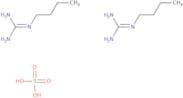
CAS 3867-74-1
:2-butylguanidine sulfate (2:1)
Description:
2-Butylguanidine sulfate (2:1) is an organic compound characterized by its guanidine structure, which features a butyl group attached to the nitrogen atom. This compound is typically encountered as a white crystalline solid and is soluble in water, making it useful in various applications, including as a reagent in organic synthesis and in biological studies. The sulfate component indicates that it forms a salt with sulfuric acid, enhancing its solubility and stability in aqueous environments. 2-Butylguanidine is known for its basicity due to the presence of the guanidine functional group, which can participate in proton transfer reactions. Additionally, it may exhibit biological activity, influencing physiological processes, although specific effects can vary based on concentration and context. Safety data should be consulted, as with any chemical substance, to understand its handling, potential hazards, and environmental impact. Overall, 2-butylguanidine sulfate serves as a versatile compound in both research and industrial applications.
Formula:C10H28N6O4S
InChI:InChI=1/2C5H13N3.H2O4S/c2*1-2-3-4-8-5(6)7;1-5(2,3)4/h2*2-4H2,1H3,(H4,6,7,8);(H2,1,2,3,4)
Sort by
Purity (%)
0
100
|
0
|
50
|
90
|
95
|
100
Found 1 products.
Bis(1-butylguanidine), sulfuric acid
CAS:Bis(1-butylguanidine), sulfuric acid (BBSS) is a disinfectant that belongs to the group of isothiocyanates. It has been shown to be an effective fungicide and bactericide in the treatment of herpesvirus infections. BBSS causes death of cells by reacting with and destroying their DNA, which is important for the production of new cell material. The reaction also results in the formation of hydroxyl radicals, which are highly reactive and destructive molecules that can damage other biomolecules such as proteins and lipids. This chemical also acts as an anesthetic by blocking nerve transmissions in certain regions of the body, such as the brain or spinal cord.Formula:C10H28N6O4SPurity:Min. 95%Molecular weight:328.44 g/mol