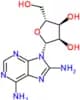
CAS 3868-33-5
:8-aminoadenosine
Description:
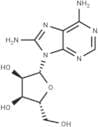
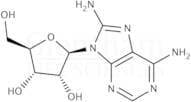
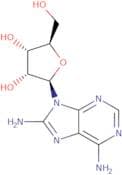
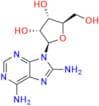
8-Aminoadenosine is a purine nucleoside derivative characterized by the presence of an amino group at the 8-position of the adenine base. This compound is structurally similar to adenosine, which consists of an adenine base linked to a ribose sugar. The introduction of the amino group enhances its potential for biological activity, making it of interest in various biochemical and pharmacological studies. 8-Aminoadenosine can participate in various biochemical pathways, potentially influencing cellular processes such as signal transduction and gene expression. It is soluble in water and exhibits properties typical of nucleosides, including the ability to form hydrogen bonds and participate in base pairing. The compound's unique structure allows it to interact with specific enzymes and receptors, which may lead to therapeutic applications. Additionally, its CAS number, 3868-33-5, serves as a unique identifier for regulatory and research purposes, facilitating its study in scientific literature and databases. Overall, 8-aminoadenosine represents a significant molecule in the field of biochemistry and molecular biology.
Formula:C10H14N6O4
InChI:InChI=1/C10H14N6O4/c11-7-4-8(14-2-13-7)16(10(12)15-4)9-6(19)5(18)3(1-17)20-9/h2-3,5-6,9,17-19H,1H2,(H2,12,15)(H2,11,13,14)/t3-,5+,6?,9-/m1/s1
Synonyms:- 9H-Purine, 6,8-diamino-9-.beta.-D-ribofuranosyl-
- Adenosine, 8-Amino-
Sort by
Purity (%)
0
100
|
0
|
50
|
90
|
95
|
100
Found 4 products.
8-Aminoadenosine
CAS:8-Aminoadenosine reduces ATP, blocks mRNA synthesis, and Akt/mTOR signaling, triggering autophagy and apoptosis independently of p53, with antitumor effects.
Formula:C10H14N6O4Color and Shape:SolidMolecular weight:282.268-Aminoadenosine
CAS:8-Aminoadenosine can be used to study the mitochondrial membrane potential, a critical cellular function in which ATP levels are maintained by oxidative phosphorylation. 8-Aminoadenosine is one of the few drugs that have been shown to increase ATP levels in cells. It does this by increasing the permeability of mitochondria membranes and the rate of electron transport from complex I to complex II. The reaction mechanism is thought to involve an intramolecular hydrogen transfer from NADH to 8-aminoadenosine, forming an unstable intermediate that undergoes a conformational change that enables it to react with oxygen. 8-Aminoadenosine has been shown as an effective treatment for certain autoimmune diseases and resistant breast cancer. It also has anti-inflammatory effects, as well as receptor activity against HIV infection and Toll-like receptors.Formula:C10H14N6O4Purity:Min. 95%Color and Shape:PowderMolecular weight:282.26 g/mol