

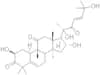
CAS 3877-86-9
:Cucurbitacin D
Description:
Cucurbitacin D is a triterpenoid compound primarily derived from various plants in the Cucurbitaceae family, such as cucumbers and gourds. It is known for its bitter taste and has been studied for its potential pharmacological properties, including anti-cancer, anti-inflammatory, and anti-diabetic effects. The molecular structure of Cucurbitacin D features a complex arrangement of carbon rings, contributing to its biological activity. It is typically found in low concentrations in plant tissues and can be extracted using organic solvents. The compound exhibits cytotoxicity against various cancer cell lines, making it a subject of interest in medicinal chemistry. Additionally, Cucurbitacin D has been shown to inhibit certain signaling pathways involved in cell proliferation and survival, further highlighting its potential therapeutic applications. However, due to its toxicity at higher concentrations, careful consideration is necessary when exploring its use in clinical settings. Overall, Cucurbitacin D represents a fascinating area of study within natural products and their potential health benefits.
Formula:C30H44O7
InChI:InChI=1S/C30H44O7/c1-25(2,36)12-11-21(33)30(8,37)23-19(32)14-27(5)20-10-9-16-17(13-18(31)24(35)26(16,3)4)29(20,7)22(34)15-28(23,27)6/h9,11-12,17-20,23,31-32,36-37H,10,13-15H2,1-8H3/b12-11+/t17-,18+,19-,20+,23+,27+,28-,29+,30+/m1/s1
InChI key:InChIKey=SRPHMISUTWFFKJ-QJNWWGCFSA-N
SMILES:C[C@]12[C@@](C)([C@@]([C@@](C(/C=C/C(C)(C)O)=O)(C)O)([C@H](O)C1)[H])CC(=O)[C@]3(C)[C@]2(CC=C4[C@]3(C[C@H](O)C(=O)C4(C)C)[H])[H]
Synonyms:- (2S,4R,9beta,16alpha,23E)-2,16,20,25-tetrahydroxy-9,10,14-trimethyl-4,9-cyclo-9,10-secocholesta-5,23-diene-1,11,22-trione
- (2β,9β,10α,16α,23E)-2,16,20,25-Tetrahydroxy-9-methyl-19-norlanosta-5,23-diene-3,11,22-trione
- 17-[(3E)-1,5-Dihydroxy-1,5-dimethyl-2-oxohex-3-en-1-yl]-2,16-dihydroxy-4,4,9,14-tetramethylestr-5-ene-3,11-dione
- 19-Nor-9β,10α-lanosta-5,23-diene-3,11,22-trione, 2β,16α,20,25-tetrahydroxy-9-methyl-
- 19-Norlanosta-5,23-diene-3,11,22-trione, 2,16,20,25-tetrahydroxy-9-methyl-, (2β,9β,10α,16α,23E)-
- Cucurbitacine D
- Elatericin A
- Elatericine A
- NSC 308606
- NSC 521776
- Cucurbitacin D
Sort by
Purity (%)
0
100
|
0
|
50
|
90
|
95
|
100
Found 10 products.
Cucurbitacin D
CAS:Cucurbitacin D analytical standard provided with w/w absolute assay, to be used for quantitative titration.Formula:C30H44O7Purity:(HPLC) ≥95%Color and Shape:PowderMolecular weight:516.6819-Norlanosta-5,23-diene-3,11,22-trione,2,16,20,25-tetrahydroxy-9-methyl-, (2b,9b,10a,16a,23E)-
CAS:Formula:C30H44O7Purity:97%Color and Shape:SolidMolecular weight:516.6662Cucurbitacin D
CAS:Cucurbitacin D is a triterpenoid isolated from Ecballium elaterium (L.) with anticancer and antitumor activity and is used in the study of cervical cancer.Formula:C30H44O7Purity:97.69% - 99.10%Color and Shape:SolidMolecular weight:516.67Cucurbitacin d
CAS:Ketone alcoholFormula:C30H44O7Purity:≥ 98.0 % (HPLC)Color and Shape:PowderMolecular weight:516.67Cucurbitacin D
CAS:Controlled ProductCucurbitacin D is a natural compound that is found in the seeds of cucurbits. It has been shown to be cytotoxic to cancer cell lines and inhibitory proteins. Cucurbitacin D binds to the response element and inhibits protein synthesis, leading to cell death by inhibiting the production of proteins vital for cell division. This compound also induces apoptosis through intracellular calcium levels. Cucurbitacin D has been shown to have significant cytotoxicity against human leukemia cells, suggesting that it could be used as a chemotherapeutic agent.Formula:C30H44O7Purity:Min. 95%Molecular weight:516.3087


