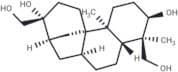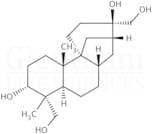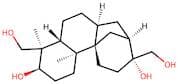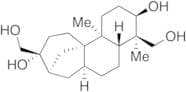
CAS 38966-21-1
:Aphidicolin
Description:
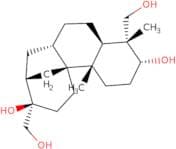
Aphidicolin is a natural product derived from the fungus *Cephalosporium aphidicola*, and it is primarily known for its role as a potent inhibitor of DNA polymerase. This compound exhibits a unique structure characterized by a tetracyclic ring system, which contributes to its biological activity. Aphidicolin specifically inhibits the replication of DNA by blocking the activity of DNA polymerase α, thereby preventing the synthesis of DNA in eukaryotic cells. This property makes it a valuable tool in molecular biology and cancer research, as it can be used to study cell cycle regulation and DNA replication processes. Additionally, aphidicolin has shown potential in various therapeutic applications, particularly in the context of cancer treatment, due to its ability to selectively target rapidly dividing cells. However, its use is limited by its toxicity and the need for careful dosage management. Overall, aphidicolin serves as an important compound in both research and potential therapeutic contexts, highlighting the intersection of natural products and medicinal chemistry.
Formula:C20H34O4
InChI:InChI=1S/C20H34O4/c1-17(11-21)15-4-3-13-9-14-10-19(13,7-8-20(14,24)12-22)18(15,2)6-5-16(17)23/h13-16,21-24H,3-12H2,1-2H3/t13-,14+,15-,16+,17-,18-,19-,20-/m0/s1
InChI key:InChIKey=NOFOAYPPHIUXJR-APNQCZIXSA-N
SMILES:C[C@@]12[C@]34[C@](C[C@](C3)([C@](CO)(O)CC4)[H])(CC[C@]1([C@@](CO)(C)[C@H](O)CC2)[H])[H]
Synonyms:- (3R,4R,4aR,6aS,8R,9R,11aS,11bS)-4,9-bis(hydroxymethyl)-4,11b-dimethyltetradecahydro-8,11a-methanocyclohepta[a]naphthalene-3,9-diol
- (3R,4R,4aR,6aS,8R,9R,11aS,11bS)-Tetradecahydro-3,9-dihydroxy-4,11b-dimethyl-8,11a-methano-11aH-cyclohepta[a]naphthalene-4,9-dimethanol
- (3R,4R,4aR,6aS,8S,9R,11aS,11bS)-4,9-bis(hydroxymethyl)-4,11b-dimethyltetradecahydro-8,11a-methanocyclohepta[a]naphthalene-3,9-diol
- 4,9-Bis(Hydroxymethyl)-4,11B-Dimethyltetradecahydro-8,11A-Methanocyclohepta[A]Naphthalene-3,9-Diol
- 8,11a-Methano-11aH-cyclohepta(a)naphthalene-4,9-dimethanol, tetradecahydro-3,9-dihydroxy-4,11b-dimethyl-, (3R-(3-alpha,4-alpha,4a-alpha,6a-beta,8-beta,9-beta,11a-beta,11b-beta))-
- 8,11a-Methano-11aH-cyclohepta[a]naphthalene-4,9-dimethanol, tetradecahydro-3,9-dihydroxy-4,11b-dimethyl-, (3R,4R,4aR,6aS,8R,9R,11aS,11bS)-
- 8,11a-Methano-11aH-cyclohepta[a]naphthalene-4,9-dimethanol, tetradecahydro-3,9-dihydroxy-4,11b-dimethyl-, [3R-(3α,4α,4aα,6aβ,8β,9β,11aβ,11bβ)]-
- 9,15-Cyclo-C,18-dinor-14,15-secoandrostane-4,17-dimethanol, 3,17-dihydroxy-4-methyl-, (3alpha,4alpha,5alpha,17alpha)-
- 9,15-Cyclo-C,18-dinor-14,15-secoandrostane-4,17-dimethanol, 3,17-dihydroxy-4-methyl-, (3α,4α,5α,17α)-
- Brn 4689958
- Ccris 1783
- Ici 69653
- Nsc 234714
- See more synonyms
Sort by
Purity (%)
0
100
|
0
|
50
|
90
|
95
|
100
Found 6 products.
Aphidicolin
CAS:Aphidicolin blocks DNA synthesis, hinders herpes virus growth, and stimulates apoptosis in leukemia cells; it's a mold-derived DNA polymerase inhibitor.Formula:C20H34O4Purity:>99.99%Color and Shape:SolidMolecular weight:338.48Aphidicolin
CAS:Formula:C20H34O4Purity:≥ 98.0%Color and Shape:White to off-white powder or solidMolecular weight:338.48Aphidicolin from Nigrospora oryzae
CAS:Aphidicolin from Nigrospora oryzaeFormula:C20H34O4Purity:99% (tlc) (Typical Value in Batch COA)Color and Shape: white powderMolecular weight:338.48156g/molRef: 54-BIA4316
1mg127.00€5mg420.00€10mg750.00€25mg1,504.00€50mg2,729.00€100mg4,950.00€200mg9,197.00€(+)-Aphidicolin
CAS:Controlled ProductApplications (+)-Aphidicolin is a naturally occurring tetracyclic diterpene with potential antiviral and antimitotical properties.
References Ganatra, S.H., et al.: J. Comp. Sys. Biol., 5, 68 (2012); Abaza, M.S. I., et al.: Tumor. Biol., 33, 1951 (2012); Brunhofer, G., et al.: Bioorg. Med. Chem., 20, 6669 (2012); Shishido, T., et al.: J. Virol., 86, 9055 (2012);Formula:C20H34O4Color and Shape:NeatMolecular weight:338.48Aphidicolin
CAS:Aphidicolin is a tetracyclic diterpenoid that acts as a potent inhibitor of DNA polymerase. Derived from the fungus *Cephalosporium aphidicola*, it is primarily identified for its ability to impede DNA synthesis by targeting eukaryotic DNA polymerase α. This selective inhibition disrupts replication processes, making it a crucial tool for studying cell cycle dynamics.Formula:C20H34O4Purity:Min. 95%Molecular weight:338.48 g/mol