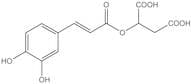
CAS 39015-77-5
:Caffeylmalic acid
Description:
Caffeylmalic acid, with the CAS number 39015-77-5, is a phenolic compound that is primarily found in certain plants, particularly in the context of plant metabolism and defense mechanisms. It is a derivative of malic acid and contains a caffeoyl group, which contributes to its antioxidant properties. This compound is characterized by its ability to scavenge free radicals, making it of interest in studies related to health benefits and potential therapeutic applications. Caffeylmalic acid is typically soluble in water and organic solvents, which facilitates its extraction from plant materials. Its structure includes both carboxylic acid and phenolic functional groups, which are responsible for its reactivity and interaction with other biological molecules. Research has indicated that caffeylmalic acid may play a role in plant stress responses and could have implications in human health, particularly in the context of anti-inflammatory and anticancer activities. However, further studies are needed to fully elucidate its biological effects and potential applications.
Formula:C13H12O8
InChI:InChI=1S/C13H12O8/c14-8-3-1-7(5-9(8)15)2-4-12(18)21-10(13(19)20)6-11(16)17/h1-5,10,14-15H,6H2,(H,16,17)(H,19,20)
InChI key:InChIKey=PMKQSEYPLQIEAY-UHFFFAOYSA-N
SMILES:C(=CC(OC(CC(O)=O)C(O)=O)=O)C1=CC(O)=C(O)C=C1
Synonyms:- 2-[[3-(3,4-Dihydroxyphenyl)-1-oxo-2-propen-1-yl]oxy]butanedioic acid
- Butanedioic acid, [[3-(3,4-dihydroxyphenyl)-1-oxo-2-propenyl]oxy]-
- Butanedioicacid, [[3-(3,4-dihydroxyphenyl)-1-oxo-2-propenyl]oxy]- (9CI)
- Caffeoylmalic acid
- Caffeylmalic acid
- Coumaroyl malic acid
- Butanedioic acid, 2-[[3-(3,4-dihydroxyphenyl)-1-oxo-2-propen-1-yl]oxy]-
Sort by
Purity (%)
0
100
|
0
|
50
|
90
|
95
|
100
Found 2 products.
Caffeoylmalic acid
CAS:Carboxylic acid with phenol functionFormula:C13H12O8Purity:≥ 95.0 % (HPLC)Color and Shape:PowderMolecular weight:296.23Caffeoylmalic acid
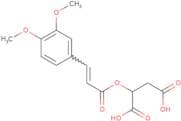
CAS:Caffeoylmalic acid is a phenolic compound, which is a type of secondary metabolite found in various plants. It is sourced mainly from fruits and leaves of certain species, notably within the Rosaceae family. This compound is part of the plant’s defense mechanism, contributing to protection against environmental stressors.Formula:C15H16O8Purity:Min. 95%Molecular weight:324.28 g/mol