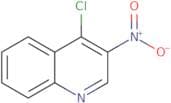
CAS 39061-97-7
:4-chloro-3-nitroquinoline
Description:
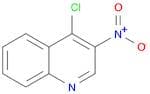
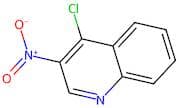
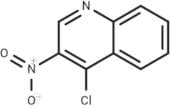
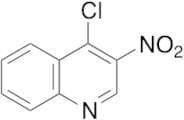
4-Chloro-3-nitroquinoline is an organic compound characterized by its quinoline structure, which consists of a fused benzene and pyridine ring. The presence of a chlorine atom at the 4-position and a nitro group at the 3-position contributes to its unique chemical properties. This compound typically appears as a yellow to orange solid and is sparingly soluble in water but more soluble in organic solvents such as ethanol and acetone. It exhibits a range of reactivity due to the electron-withdrawing effects of the nitro group and the halogen substituent, making it a potential candidate for various chemical reactions, including nucleophilic substitutions and electrophilic aromatic substitutions. 4-Chloro-3-nitroquinoline may also possess biological activity, which has been explored in medicinal chemistry, particularly in the development of pharmaceuticals. As with many nitro compounds, it is important to handle this substance with care due to potential toxicity and environmental concerns. Proper safety protocols should be followed when working with this compound in laboratory settings.
Formula:C9H5ClN2O2
InChI:InChI=1/C9H5ClN2O2/c10-9-6-3-1-2-4-7(6)11-5-8(9)12(13)14/h1-5H
SMILES:c1ccc2c(c1)c(c(cn2)N(=O)=O)Cl
Synonyms:- QUINOLINE, 4-CHLORO-3-NITRO-
- 4-CHLORO-3-NITROQUINOLINE
- 4-Chloro-3-nitroquinoline ,98%
Sort by
Purity (%)
0
100
|
0
|
50
|
90
|
95
|
100
Found 7 products.
4-Chloro-3-Nitroquinoline
CAS:Formula:C9H5ClN2O2Purity:98%Color and Shape:SolidMolecular weight:208.60124-Chloro-3-nitroquinoline
CAS:Heterocyclic Compounds - Quinolines; Intermediates and Building Blocks –ElectrophilesFormula:C9H5ClN2O2Color and Shape:SolidMolecular weight:208.6Ref: TM-TNU0902
5mgTo inquire10mgTo inquire25mgTo inquire50mgTo inquire100mgTo inquire500mgTo inquire4-Chloro-3-nitroquinoline
CAS:Formula:C9H5ClN2O2Purity:97%Color and Shape:SolidMolecular weight:208.64-Chloro-3-nitroquinoline
CAS:Controlled ProductFormula:C9H5ClN2O2Color and Shape:NeatMolecular weight:208.64-Chloro-3-nitroquinoline
CAS:4-Chloro-3-nitroquinoline is a quinoline derivative that can be synthesized by cross-coupling reaction. The amide and n-oxide functional groups are the most reactive sites. It can react with nucleophiles such as haloamines, azides, and pyridazines to form covalent bonds. 4-Chloro-3-nitroquinoline has been shown to have anti-HIV activity in vitro and in vivo in animal models. In addition, this compound has shown potential use for the treatment of leishmania.Formula:C9H5ClN2O2Purity:Min. 95%Color and Shape:Slightly Yellow PowderMolecular weight:208.6 g/mol