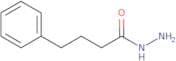
CAS 39181-61-8
:4-phenylbutanehydrazide
Description:
4-Phenylbutanehydrazide, with the CAS number 39181-61-8, is an organic compound characterized by the presence of a hydrazide functional group attached to a butane chain that is further substituted with a phenyl group. This compound typically appears as a solid and is known for its potential applications in organic synthesis and medicinal chemistry. The hydrazide moiety can participate in various chemical reactions, including condensation and hydrazone formation, making it a versatile intermediate in the synthesis of more complex molecules. Its structure suggests that it may exhibit specific reactivity patterns, such as nucleophilic behavior due to the presence of the hydrazine nitrogen. Additionally, compounds like 4-phenylbutanehydrazide may possess biological activity, which could be explored in pharmacological studies. However, detailed information regarding its physical properties, such as solubility, melting point, and specific reactivity, would require further investigation or empirical data. As with any chemical substance, safety data sheets should be consulted for handling and safety precautions.
Formula:C10H14N2O
InChI:InChI=1/C10H14N2O/c11-12-10(13)8-4-7-9-5-2-1-3-6-9/h1-3,5-6H,4,7-8,11H2,(H,12,13)
Synonyms:- Benzenebutanoic Acid, Hydrazide
Sort by
Purity (%)
0
100
|
0
|
50
|
90
|
95
|
100
Found 1 products.
4-Phenylbutanehydrazide
CAS:4-Phenylbutanehydrazide is a nitro, carbonyl group and hydrogen bond donor. It has an interaction with the benzyl group of 4-phenylbutanoylhydrazide through hydrogen bonds. The conformation of 4-phenylbutanehydrazide is agonistic and its secondary structure is mainly determined by the carbonyl group. The carbonyl group interacts with the hydrazide nucleus through a hydrogen bond, while its acylhomoserine residue interacts with the carbonyl group through a thiocarbamate interaction. This compound may be classified as an agonist or antagonist depending on the receptor it binds to.Formula:C10H14N2OPurity:Min. 95%Molecular weight:178.23 g/mol