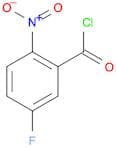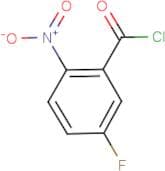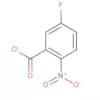
CAS 394-02-5
:Benzoyl chloride, 5-fluoro-2-nitro-
Description:
Benzoyl chloride, 5-fluoro-2-nitro- is an organic compound characterized by the presence of a benzoyl group, a nitro group, and a fluorine atom attached to a benzene ring. Its molecular structure features a carbonyl group (C=O) directly bonded to a chlorine atom, making it a reactive acyl chloride. The presence of the nitro group (–NO2) and the fluorine atom (–F) introduces both electron-withdrawing effects, which can influence the compound's reactivity and polarity. This compound is typically used in organic synthesis, particularly in the preparation of various pharmaceuticals and agrochemicals. It is important to handle benzoyl chloride, 5-fluoro-2-nitro- with care, as it can be corrosive and may cause irritation upon contact with skin or mucous membranes. Additionally, it is sensitive to moisture, which can lead to hydrolysis, forming benzoic acid and hydrochloric acid. Proper safety protocols should be followed when working with this compound in a laboratory setting.
Formula:C7H3ClFNO3
Sort by
Purity (%)
0
100
|
0
|
50
|
90
|
95
|
100
Found 4 products.
5-Fluoro-2-Nitrobenzoyl chloride
CAS:Formula:C7H3ClFNO3Purity:95%Color and Shape:LiquidMolecular weight:203.55505-Fluoro-2-nitrobenzoyl chloride
CAS:5-Fluoro-2-nitrobenzoyl chloridePurity:95%Molecular weight:203.56g/mol5-Fluoro-2-nitrobenzoyl chloride
CAS:5-Fluoro-2-nitrobenzoyl chloride is a conformationally locked macrocyclic compound that has been synthesized by solid phase synthesis. It is found in two conformational states and can be made to switch between these two states by applying a force to the molecule. This conformation can be controlled by changing the side chain of 5-fluoro-2-nitrobenzoyl chloride, which can be done experimentally. The conformational behavior of this macrocycle was studied using molecular dynamics simulations and it was found that there are four possible conformations for the molecule. The conformations with different side chains were found to have different energies, which could be used as a measure of their relative stability.
Formula:C7H3ClFNO3Purity:Min. 95%Molecular weight:203.55 g/mol