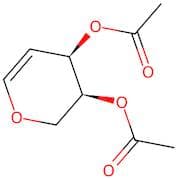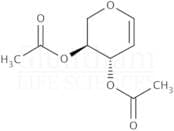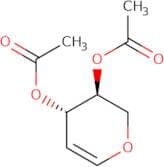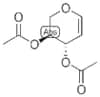
CAS 3945-18-4
:3,4-Di-O-acetyl-L-arabinal
- 2,3-di-O-acetyl-1,5-anhydro-4-deoxy-D-erythro-pent-4-enitol
- 3,4-Di-O-acetyl-<span class="text-smallcaps">L</span>-arabinal
- <span class="text-smallcaps">D</span>-erythro-Pent-4-enitol, 1,5-anhydro-4-deoxy-, 2,3-diacetate
- <span class="text-smallcaps">D</span>-erythro-Pent-4-enitol, 1,5-anhydro-4-deoxy-, diacetate
- <span class="text-smallcaps">L</span>-Arabinal 3,4-diacetate
- <span class="text-smallcaps">L</span>-erythro-Pent-1-enopyranose, 1,2-dideoxy-, diacetate
- Arabinal, 3,4-diacetate, <span class="text-smallcaps">L</span>-
- L-Arabinal 3,4-diacetate
- D-erythro-Pent-4-enitol, 1,5-anhydro-4-deoxy-, 2,3-diacetate
- Arabinal, 3,4-diacetate, L-
- L-erythro-Pent-1-enopyranose, 1,2-dideoxy-, diacetate
- See more synonyms
(3S,4R)-3,4-Dihydro-2H-pyran-3,4-diyl diacetate
CAS:(3S,4R)-3,4-Dihydro-2H-pyran-3,4-diyl diacetatePurity:95%Molecular weight:200.19g/mol3,4-Di-O-acetyl-L-arabinal
CAS:3,4-Di-O-acetyl-L-arabinal is a synthetic compound that belongs to the class of monofluorides. It has been synthesized from l-arabinose by a stereoselective process, with triflic acid as the catalyst and propargylation as the key step. The synthetic pathway starts from an acid hydrolysis of L-arabinose to yield 3,4-di-O-acetyl-L-arabinonic acid. This acid is then converted to 3,4 diacetyl L arabinonic acid with acetic anhydride and acetic acid in the presence of triethylamine. The final product is then obtained by reacting this intermediate with 1 equivalent of sodium fluoride in tetrahydrofuran (THF) using catalytic reduction with sodium borohydride at 0 °C. The major advantage of this synthetic process is that it provides two stereoisomers: (
Formula:C9H12O5Purity:Min. 95%Color and Shape:Yellow Clear LiquidMolecular weight:200.19 g/mol