CAS 39604-60-9
:1H-Pyrrole-2,5-dicarboxaldehyde
Description:
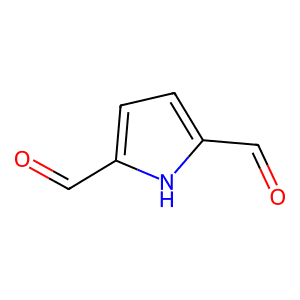
1H-Pyrrole-2,5-dicarboxaldehyde is an organic compound characterized by its pyrrole ring structure, which is a five-membered aromatic heterocycle containing nitrogen. This compound features two aldehyde functional groups located at the 2 and 5 positions of the pyrrole ring, making it a dicarboxaldehyde. It is typically a colorless to pale yellow liquid or solid, depending on the temperature and purity. The presence of aldehyde groups contributes to its reactivity, allowing it to participate in various chemical reactions, such as condensation and polymerization. 1H-Pyrrole-2,5-dicarboxaldehyde is of interest in organic synthesis and materials science, particularly in the development of dyes, pharmaceuticals, and agrochemicals. Its properties include solubility in polar organic solvents, and it may exhibit fluorescence under certain conditions. Safety precautions should be taken when handling this compound, as aldehydes can be irritants and potentially harmful. Overall, 1H-Pyrrole-2,5-dicarboxaldehyde is a versatile building block in synthetic organic chemistry.
Formula:C6H5NO2
Sort by
Purity (%)
0
100
|
0
|
50
|
90
|
95
|
100
Found 5 products.
PYRROLE-2,5-DICARBOXALDEHYDE
CAS:Formula:C6H5NO2Purity:95%Color and Shape:SolidMolecular weight:123.10941H-Pyrrole-2,5-dicarbaldehyde
CAS:Controlled ProductFormula:C6H5NO2Color and Shape:NeatMolecular weight:123.1091H-Pyrrole-2,5-dicarbaldehyde
CAS:1H-Pyrrole-2,5-dicarbaldehyde is a molecule that has been shown to have antibacterial properties. It binds to the amine nitrogen of the protein and forms an imine intermediate. This intermediate will react with other molecules to form a condensation product. The condensation product is then hydrolyzed by water or ammonium hydroxide to release 1H-pyrrole-2,5-dicarbaldehyde. 1H-Pyrrole-2,5-dicarbaldehyde has been shown to be effective against bacteria such as Staphylococcus aureus and Pseudomonas aeruginosa in bioassays. X-ray diffraction data supports the idea that this molecule has an intramolecular hydrogen bond between the carbonyl group and the nitrogen atom. This reactive molecule also has mononuclear nitrogen atoms that can bind to anions such as chloride ions and nitrate ions, which areFormula:C6H5NO2Purity:Min. 95%Molecular weight:123.11 g/mol