CAS 39640-51-2
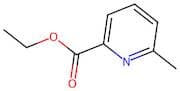
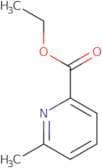
:2-Pyridinecarboxylic acid, 6-methyl-, ethyl ester
Description:
2-Pyridinecarboxylic acid, 6-methyl-, ethyl ester, also known as ethyl 6-methylpyridine-2-carboxylate, is an organic compound characterized by its pyridine ring structure with a carboxylic acid group and an ethyl ester functional group. This compound typically appears as a colorless to pale yellow liquid with a distinctive aromatic odor. It is soluble in organic solvents such as ethanol and ether but has limited solubility in water due to its hydrophobic ethyl ester group. The presence of the methyl group at the 6-position of the pyridine ring influences its reactivity and physical properties, making it a useful intermediate in organic synthesis and pharmaceutical applications. The compound may exhibit moderate toxicity and should be handled with care, following appropriate safety protocols. Its applications can include use in the synthesis of various chemical compounds, agrochemicals, and as a potential building block in medicinal chemistry.
Formula:C9H11NO2
InChI:InChI=1S/C9H11NO2/c1-3-12-9(11)8-6-4-5-7(2)10-8/h4-6H,3H2,1-2H3
InChI key:InChIKey=FMSXHQBTRLUYHP-UHFFFAOYSA-N
SMILES:C(OCC)(=O)C=1N=C(C)C=CC1
Synonyms:- 2-Pyridinecarboxylic Acid, 6-Methyl-, Ethyl Ester
- 6-Methylpicolinic acid ethyl ester
- 6-Methylpyridine-2-carboxylic acid ethyl ester
- Ethyl 6-methyl-2-pyridinecarboxylate
- Ethyl 6-methylpicolinate
- Picolinic acid, 6-methyl-, ethyl ester
- Ethyl 6-methylpyridine-2-carboxylate
Sort by
Purity (%)
0
100
|
0
|
50
|
90
|
95
|
100
Found 4 products.
ETHYL 6-METHYLPYRIDINE-2-CARBOXYLATE
CAS:Formula:C9H11NO2Purity:97%Color and Shape:LiquidMolecular weight:165.18916-Methylpyridine-2-Carboxylic Acid Ethyl Ester
CAS:6-Methylpyridine-2-Carboxylic Acid Ethyl EsterPurity:97%Molecular weight:165.19g/molEthyl 6-methylpyridine-2-carboxylate
CAS:Ethyl 6-methylpyridine-2-carboxylate is a pyridine derivative that has a nitrogen at the 6 position. It is an anionic compound, which is soluble in methanol and dichloromethane. The compound can be used to synthesize pharmaceuticals or as a precursor for polymers. It has been shown to inhibit the growth of tumor cells by binding to type 1 receptor sites on the surface of cancer cells. It also binds to quinine and enolate groups, which are found in many drugs. These binding sites may be exploited for drug design purposes.Formula:C9H11NO2Purity:Min. 95%Molecular weight:165.19 g/mol