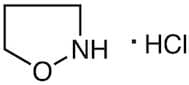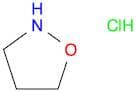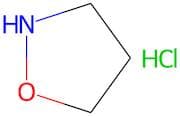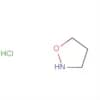
CAS 39657-45-9
:Isoxazolidine, hydrochloride
Description:
Isoxazolidine, hydrochloride is a chemical compound characterized by its cyclic structure containing both an isoxazolidine ring and a hydrochloride moiety. This compound typically appears as a white to off-white crystalline solid and is soluble in water, which is a common trait for many hydrochloride salts. Isoxazolidines are known for their potential applications in medicinal chemistry, particularly in the development of pharmaceuticals due to their ability to act as intermediates in organic synthesis. The presence of the hydrochloride group enhances the stability and solubility of the compound, making it easier to handle in various chemical reactions and formulations. Additionally, isoxazolidines can exhibit biological activity, which may include antimicrobial or anti-inflammatory properties, although specific activities can vary based on the substituents on the isoxazolidine ring. As with any chemical substance, proper safety measures should be observed when handling isoxazolidine, hydrochloride, including the use of personal protective equipment and adherence to safety data sheet guidelines.
Formula:C3H7NO・ClH
Sort by
Purity (%)
0
100
|
0
|
50
|
90
|
95
|
100
Found 5 products.
Isoxazolidine Hydrochloride
CAS:Formula:C3H7NO·HClPurity:>97.0%(T)Color and Shape:White to Almost white powder to crystalMolecular weight:109.55Isoxazolidine hydrochloride
CAS:Formula:C3H8ClNOPurity:95%Color and Shape:SolidMolecular weight:109.55471,2-Oxazolidine hydrochloride
CAS:1,2-Oxazolidine hydrochloridePurity:95%Molecular weight:109.55g/molisoxazolidine hydrochloride
CAS:Formula:C3H8ClNOPurity:95%Color and Shape:SolidMolecular weight:109.551,2-Oxazolidine hydrochloride
CAS:1,2-Oxazolidine hydrochloride (1,2-OH) is an organic compound that is used as a reagent in organic synthesis. It is a chloride salt of the squaramide 1,2-oxazolidine and it reacts with hydrochloric acid to form the corresponding isoxazolidine. This process can be used to regenerate the starting reagent from a reaction mixture. The reaction yield for this process is in excess of 90%. 1,2-OH has shown pain control effects in mice and rats through its ability to inhibit prostaglandin synthesis. It also binds to c1-c6 alkoxyamines and iminiums, which are important intermediates in drug synthesis.Formula:C3H8ClNOPurity:Min. 95%Molecular weight:109.55 g/mol