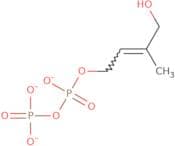
![Diphosphoric acid, mono[(2E)-4-hydroxy-3-methyl-2-butenyl] ester](/_next/image/?url=https%3A%2Fstatic.cymitquimica.com%2Fcas-image%2Fthumb-webp%2F78942-diphosphoric-acid-mono-2e-4-hydroxy-3-methyl-2-butenyl-ester.webp&w=3840&q=75)
CAS 396726-03-7
:Diphosphoric acid, mono[(2E)-4-hydroxy-3-methyl-2-butenyl] ester
Description:
Diphosphoric acid, mono[(2E)-4-hydroxy-3-methyl-2-butenyl] ester, identified by CAS number 396726-03-7, is an organic compound characterized by its ester functional group derived from diphosphoric acid. This compound features a hydroxy group and a branched alkene structure, which contributes to its reactivity and potential applications in various chemical processes. The presence of the diphosphoric acid moiety suggests that it may exhibit properties typical of phosphoric acid derivatives, such as being a potential source of phosphate groups in biochemical reactions. Additionally, the hydroxy and alkene functionalities may impart unique characteristics, such as the ability to participate in hydrogen bonding and undergo polymerization or other chemical transformations. The compound's structure indicates it may be of interest in fields such as biochemistry, agriculture, or materials science, particularly in the development of fertilizers or as a biochemical reagent. However, specific applications and behavior would depend on further empirical studies and characterization.
Formula:C5H12O8P2
Sort by
Purity (%)
0
100
|
0
|
50
|
90
|
95
|
100
Found 2 products.
(E)-1-Hydroxy-2-Methyl-2-Butenyl 4-Pyrophosphate Lithium Salt
CAS:Formula:C5H12O8P2·xLiMolecular weight:262.09 x6.941-Hydroxy-2-methyl-2-buten-4-yl 4-diphosphate
CAS:1-Hydroxy-2-methyl-2-buten-4-yl 4-diphosphate is an enzyme that has been found to inhibit the polymerase chain reaction in mammalian cells. It also inhibits the growth of bacteria. 1,3,5(10)-triphosphates are important compounds in plant metabolism and have been shown to induce apoptosis in TNF related apoptosis inducing factor (TRAF) protein. This compound is also used as a pharmacological agent. It has been shown to be active against camptotheca acuminata, which causes the disease Camptotheca acuminata. This drug is also able to control histochemical staining and has been shown to have antimicrobial properties against prokaryotes and eukaryotes.Formula:C5H9O8P2Purity:Min. 95%Molecular weight:259.07 g/mol