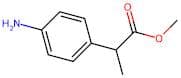
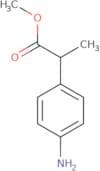
CAS 39718-97-3
:Methyl 4-amino-α-methylbenzeneacetate
Description:
Methyl 4-amino-α-methylbenzeneacetate, identified by its CAS number 39718-97-3, is an organic compound characterized by the presence of an amino group and an ester functional group. This compound features a methyl group attached to a benzene ring, which is further substituted with an amino group at the para position and an acetate moiety. The molecular structure contributes to its potential applications in various fields, including pharmaceuticals and organic synthesis. Methyl 4-amino-α-methylbenzeneacetate is typically a solid at room temperature and may exhibit moderate solubility in organic solvents, while its solubility in water can vary. The compound's reactivity is influenced by the amino and ester groups, allowing for potential derivatization and participation in various chemical reactions, such as acylation or amidation. Safety data should be consulted for handling and storage, as with any chemical substance, to ensure proper precautions are taken due to potential toxicity or reactivity.
Formula:C10H13NO2
InChI:InChI=1S/C10H13NO2/c1-7(10(12)13-2)8-3-5-9(11)6-4-8/h3-7H,11H2,1-2H3
InChI key:InChIKey=JSQLPIGKVBUMBF-UHFFFAOYSA-N
SMILES:C(C(OC)=O)(C)C1=CC=C(N)C=C1
Synonyms:- 2-(4-Aminophenyl)propionic acid methyl ester
- Benzeneacetic acid, 4-amino-α-methyl-, methyl ester
- Hydratropic acid, p-amino-, methyl ester
- Methyl 2-(4-Aminophenyl)Propanoate
- Methyl 2-(p-aminophenyl)propionate
- Methyl 4-amino-α-methylbenzeneacetate
- Methyl 2-(4-aminophenyl)propionate
Sort by
Purity (%)
0
100
|
0
|
50
|
90
|
95
|
100
Found 4 products.
Methyl 2-(4-aminophenyl)propanoate
CAS:Methyl 2-(4-aminophenyl)propanoatePurity:98%Molecular weight:179.22g/molmethyl 2-(4-aminophenyl)propanoate
CAS:Methyl 2-(4-aminophenyl)propanoate is a fatty acid amide that is derived from the arachidonic acid. It has been shown to be a lead compound with non-competitive inhibition of anandamide hydrolase. Methyl 2-(4-aminophenyl)propanoate also inhibits other hydrolases, such as the N-acylphosphatidylethanolamine phospholipase D and the phospholipase A2. This drug has been shown to have several effects in tissues, including cannabinoid receptors, which may be due to its ability to inhibit endocannabinoid metabolism and hydrolysis. This drug has also been shown to have anti-inflammatory properties.Formula:C10H13NO2Purity:Min. 95%Molecular weight:179.2 g/mol