CAS 39723-40-5
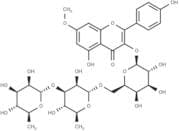
:5-hydroxy-2-(4-hydroxyphenyl)-7-methoxy-4-oxo-4H-chromen-3-yl 6-deoxy-alpha-L-mannopyranosyl-(1->3)-6-deoxy-alpha-L-mannopyranosyl-(1->6)-beta-D-galactopyranoside
Description:
The chemical substance known as "5-hydroxy-2-(4-hydroxyphenyl)-7-methoxy-4-oxo-4H-chromen-3-yl 6-deoxy-alpha-L-mannopyranosyl-(1->3)-6-deoxy-alpha-L-mannopyranosyl-(1->6)-beta-D-galactopyranoside," with the CAS number 39723-40-5, is a complex glycoside. It features a chromone backbone, which is characterized by a benzopyran structure that includes a hydroxyl group and a methoxy group, contributing to its potential biological activity. The presence of multiple sugar moieties, specifically 6-deoxy-alpha-L-mannopyranosyl units linked through glycosidic bonds to a beta-D-galactopyranoside, suggests that this compound may exhibit properties typical of flavonoids and glycosides, such as antioxidant activity. Its structural complexity indicates potential interactions with biological systems, which may be of interest in pharmacological research. The compound's solubility, stability, and reactivity would depend on its specific functional groups and the overall molecular structure, making it a candidate for further studies in medicinal chemistry and natural product research.
Formula:C34H42O19
InChI:InChI=1/C34H42O19/c1-11-20(37)24(41)26(43)33(49-11)52-30-21(38)12(2)48-32(28(30)45)47-10-18-22(39)25(42)27(44)34(51-18)53-31-23(40)19-16(36)8-15(46-3)9-17(19)50-29(31)13-4-6-14(35)7-5-13/h4-9,11-12,18,20-22,24-28,30,32-39,41-45H,10H2,1-3H3/t11-,12-,18+,20-,21-,22-,24+,25-,26+,27+,28+,30+,32+,33-,34-/m0/s1
Synonyms:- Catharticin
Sort by
Purity (%)
0
100
|
0
|
50
|
90
|
95
|
100
Found 2 products.
Catharticin
CAS:Catharticin is a natural product for research related to life sciences. The catalog number is TN3611 and the CAS number is 39723-40-5.Formula:C34H42O19Purity:98%Color and Shape:SolidMolecular weight:754.69Catharticin
CAS:Controlled ProductCatharticin is an alkaloid compound, which is primarily derived from plant-based sources, notably within the families of some toxic plant species. Its mode of action involves disrupting cellular processes by interacting with DNA enzymes, leading to apoptosis in certain cell lines. This mechanism is facilitated by intercalation with DNA, inhibiting critical cellular replication machinery, making it a potent tool for probing cellular pathways and potential chemotherapy applications.
Formula:C34H42O19Purity:Min. 95%Molecular weight:754.70 g/mol