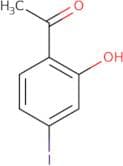
CAS 39730-66-0
:1-(2-hydroxy-4-iodo-phenyl)ethanone
Description:
1-(2-Hydroxy-4-iodo-phenyl)ethanone, also known by its CAS number 39730-66-0, is an organic compound characterized by the presence of a phenolic hydroxyl group and an iodo substituent on the aromatic ring. This compound features a ketone functional group, specifically an acetophenone derivative, where the acetyl group is attached to a phenyl ring that has a hydroxyl group at the ortho position and an iodine atom at the para position. The presence of the hydroxyl group contributes to its potential as a phenolic compound, which can exhibit various chemical reactivity, including hydrogen bonding and participation in electrophilic aromatic substitution reactions. The iodine atom enhances the compound's reactivity and can influence its biological activity, making it of interest in medicinal chemistry. Additionally, the compound may exhibit unique physical properties such as solubility in organic solvents and specific melting or boiling points, which are influenced by the functional groups present. Overall, this compound's structure suggests potential applications in pharmaceuticals and materials science.
Formula:C8H7IO2
InChI:InChI=1/C8H7IO2/c1-5(10)7-3-2-6(9)4-8(7)11/h2-4,11H,1H3
SMILES:CC(=O)c1ccc(cc1O)I
Sort by
Purity (%)
0
100
|
0
|
50
|
90
|
95
|
100
Found 3 products.
1-(2-Hydroxy-4-iodophenyl)ethan-1-one
CAS:<p>1-(2-Hydroxy-4-iodophenyl)ethan-1-one is a monomer that is used in the synthesis of polymers. It can be synthesized by irradiation of benzene with ultraviolet light. Yields are monitored by spectroscopies, such as elemental analysis, UV/visible spectroscopy, and IR spectroscopy. The reaction is carried out in organic solvents and yields 1-(2-hydroxy-4-iodophenyl)ethanone as an intermediate product. This compound can be polymerized using various methods to produce polymers with different properties. One method involves the use of benzene as a solvent and uv radiation for activation. 1-(2-Hydroxyphenyl)ethanone can also be polymerized using a metal catalyst (e.g., zinc). Theoretical models have been developed to predict the potential yields for this reaction.<br>END>></p>Formula:C8H7IO2Purity:Min. 95%Molecular weight:262.04 g/mol