![tricyclo[3.3.1.1~3,7~]decane-2,6-dione](/_next/image/?url=https%3A%2Fstatic.cymitquimica.com%2Fcas-image%2Fthumb-webp%2F105166-tricyclo-3-3-1-1-37-decane-26-dione.webp&w=3840&q=75)
CAS 39751-07-0
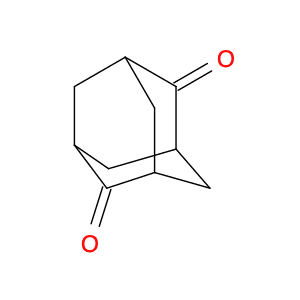
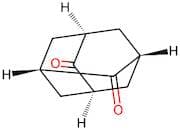
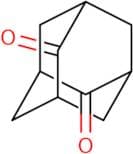
:tricyclo[3.3.1.1~3,7~]decane-2,6-dione
Description:
Tricyclo[3.3.1.1^3,7]decane-2,6-dione, with the CAS number 39751-07-0, is a bicyclic organic compound characterized by its unique tricyclic structure. This compound features a decane backbone with two ketone functional groups located at the 2 and 6 positions, contributing to its reactivity and potential applications in organic synthesis. The presence of the tricyclic framework imparts rigidity to the molecule, influencing its physical properties such as melting and boiling points, which are typically higher than those of more flexible compounds. Tricyclo[3.3.1.1^3,7]decane-2,6-dione may exhibit interesting chemical behavior, including the ability to undergo various reactions typical of diketones, such as condensation and oxidation. Its structural complexity makes it a subject of interest in the study of organic chemistry, particularly in the synthesis of more complex molecules and materials. Additionally, the compound's unique arrangement may lead to specific interactions in biological systems, warranting further investigation into its potential applications in pharmaceuticals or materials science.
Formula:C10H12O2
InChI:InChI=1/C10H12O2/c11-9-5-1-6-3-8(9)4-7(2-5)10(6)12/h5-8H,1-4H2
SMILES:C1C2CC3CC(CC1C3=O)C2=O
Synonyms:- 2,6-Adamantandione
- Adamantane-2,6-dione
Sort by
Purity (%)
0
100
|
0
|
50
|
90
|
95
|
100
Found 5 products.
2,6-Adamantanedione
CAS:2,6-Adamantanedione is a molecule that is used in the synthesis of other compounds. It has two functional groups, one of which is a chromatographically detectable group. 2,6-Adamantanedione has been shown to react with silver ions and form potential impurities in the synthesized compound. The molecule has also been shown to react with organic materials such as perfluorinated compounds.
2,6-Adamantanedione is an interpretable drug substance that can be used for palladium-catalyzed cross-coupling reactions involving multigram quantities. This molecule has x-ray crystal structures that can be analyzed by nmr spectroscopy and steric interactions that can be examined using perfluorinated compounds.Formula:C10H12O2Color and Shape:PowderMolecular weight:164.2 g/molRef: 3D-FA66829
Discontinued product