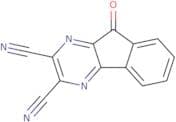
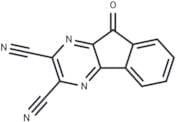
![9-oxo-9H-indeno[1,2-b]pyrazine-2,3-dicarbonitrile](/_next/image/?url=https%3A%2Fstatic.cymitquimica.com%2Fcas-image%2Fthumb-webp%2F298260-9-oxo-9h-indeno-12-b-pyrazine-23-dicarbonitrile.webp&w=3840&q=75)
CAS 40114-84-9
:9-oxo-9H-indeno[1,2-b]pyrazine-2,3-dicarbonitrile
Description:
9-Oxo-9H-indeno[1,2-b]pyrazine-2,3-dicarbonitrile is a heterocyclic compound characterized by its unique fused ring structure, which includes an indeno and pyrazine moiety. This compound features two cyano groups (-C≡N) at the 2 and 3 positions of the pyrazine ring, contributing to its reactivity and potential applications in organic synthesis and materials science. The presence of the keto group (9-oxo) enhances its electrophilic character, making it a candidate for various chemical reactions, including nucleophilic additions. The compound is typically solid at room temperature and may exhibit moderate solubility in polar organic solvents. Its structural complexity and functional groups suggest potential utility in pharmaceuticals, agrochemicals, or as a building block in organic synthesis. Additionally, the presence of multiple functional groups may impart interesting optical or electronic properties, making it a subject of interest in research related to organic electronics or dye chemistry. As with many such compounds, safety data should be consulted before handling, as it may pose health risks.
Formula:C13H4N4O
InChI:InChI=1/C13H4N4O/c14-5-9-10(6-15)17-12-11(16-9)7-3-1-2-4-8(7)13(12)18/h1-4H
SMILES:c1ccc2c(c1)c1c(C2=O)nc(C#N)c(C#N)n1
Synonyms:- 9H-Indeno[1,2-b]pyrazine-2,3-dicarbonitrile, 9-oxo-
- 9-Oxo-9H-indeno[1,2-b]pyrazin-2,3-dicarbonitril
Sort by
Purity (%)
0
100
|
0
|
50
|
90
|
95
|
100
Found 5 products.
9H-Indeno[1,2-b]pyrazine-2,3-dicarbonitrile, 9-oxo-
CAS:Formula:C13H4N4OPurity:98%Color and Shape:SolidMolecular weight:232.19719-Oxo-9H-indeno[1,2-b]pyrazine-2,3-dicarbonitrile
CAS:9-Oxo-9H-indeno[1,2-b]pyrazine-2,3-dicarbonitrilePurity:98%Molecular weight:232.20g/molHBX
CAS:HBX is a virus that infects humans and causes hepatitis B. It has been shown to replicate in human liver cells, where it produces an HBV-DNA polymerase. HBX protein has been shown to interact with the c-Src tyrosine kinase, which may play a role in its replication. HBX is also believed to contribute to tumorigenesis by activating the transcription factor NF-κB and inducing cell proliferation in some human cancer cells.Formula:C13H4N4OPurity:Min. 95%Molecular weight:232.2 g/molHBX
CAS:HBX blocks deubiquitinase USP7, reducing HAdV-C5 replication and oncogenesis, but doesn't affect adenovirus types 12 and 31.Formula:C13H4N4OColor and Shape:SolidMolecular weight:232.2
![9H-Indeno[1,2-b]pyrazine-2,3-dicarbonitrile, 9-oxo-](/_next/image/?url=https%3A%2Fstatic.cymitquimica.com%2Fproducts%2FIN%2Fthumb%2FDA00C6E3.jpg&w=3840&q=75)

![9-Oxo-9H-indeno[1,2-b]pyrazine-2,3-dicarbonitrile](/_next/image/?url=https%3A%2Fstatic.cymitquimica.com%2Fproducts%2F54%2Fthumb%2FOR83024.jpg&w=3840&q=75)

![9-Oxo-9H-indeno[1,2-b]pyrazine-2,3-dicarbonitrile](/_next/image/?url=https%3A%2Fstatic.cymitquimica.com%2Fproducts%2F10%2Fthumb%2FF787794.jpg&w=3840&q=75)