CAS 40176-80-5
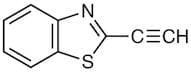
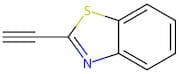
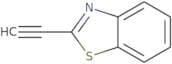
:2-ethynyl-1,3-benzothiazole
Description:
2-Ethynyl-1,3-benzothiazole is an organic compound characterized by its unique structure, which includes a benzothiazole ring fused with an ethynyl group. This compound typically exhibits a pale yellow to light brown appearance and is known for its potential applications in various fields, including materials science and organic synthesis. It possesses a relatively high melting point and is soluble in organic solvents, making it suitable for use in formulations and reactions requiring non-polar environments. The presence of the ethynyl group contributes to its reactivity, allowing it to participate in various chemical reactions, such as cross-coupling and polymerization. Additionally, 2-ethynyl-1,3-benzothiazole may exhibit interesting photophysical properties, which can be harnessed in the development of fluorescent materials or sensors. Safety data indicates that, like many organic compounds, it should be handled with care, as it may pose health risks if inhaled or ingested. Overall, its distinctive chemical structure and properties make it a compound of interest in both research and industrial applications.
Formula:C9H5NS
InChI:InChI=1/C9H5NS/c1-2-9-10-7-5-3-4-6-8(7)11-9/h1,3-6H
SMILES:C#Cc1nc2ccccc2s1
Synonyms:- Benzothiazole, 2-Ethynyl-
Sort by
Purity (%)
0
100
|
0
|
50
|
90
|
95
|
100
Found 5 products.
2-Ethynylbenzothiazole
CAS:Formula:C9H5NSPurity:>97.0%(GC)Color and Shape:White to Light yellow to Light orange powder to crystalMolecular weight:159.212-Ethynyl-1,3-benzothiazole
CAS:Formula:C9H5NSPurity:97%Color and Shape:SolidMolecular weight:159.20772-Ethynylbenzothiazole
CAS:2-Ethynylbenzothiazole is a synthetic chemical that can be used as a fluorescent probe. It has been shown to react with nucleophilic compounds, such as thiols and amines, in the presence of palladium complexes. The reaction is catalyzed by the addition of hydrogen chloride. 2-Ethynylbenzothiazole reacts with thiols and amines to form a new compound called 2-chlorobenzothiazole. This reaction also produces hydrogen gas and heat. When 2-ethynylbenzothiazole is combined with vitamin B1, it undergoes electrophilic attack by an electron-rich heterocycle, leading to the formation of an intermediate product that fluoresces brightly.Formula:C9H5NSPurity:Min. 95%Molecular weight:159.21 g/mol