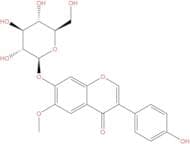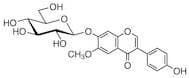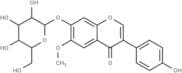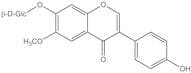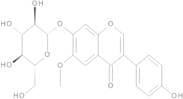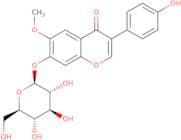
CAS 40246-10-4
:Glycitin
Description:
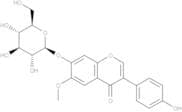
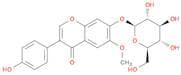
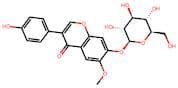
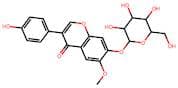
Glycitin, with the CAS number 40246-10-4, is a naturally occurring isoflavone glycoside primarily found in soybeans and other legumes. It is a derivative of the isoflavone genistein, where a glucose molecule is attached, enhancing its solubility and bioavailability. Glycitin exhibits antioxidant properties, contributing to its potential health benefits, including anti-inflammatory effects and possible roles in hormone regulation. As a phytoestrogen, it can mimic estrogen in the body, which may have implications for menopausal symptoms and bone health. Glycitin is often studied for its potential therapeutic applications in various health conditions, including cancer and cardiovascular diseases. In terms of physical properties, glycitin is typically a white to off-white powder, soluble in water, and stable under normal storage conditions. Its safety profile is generally considered favorable, although further research is ongoing to fully understand its biological effects and mechanisms of action.
Formula:C22H22O10
InChI:InChI=1S/C22H22O10/c1-29-15-6-12-14(30-9-13(18(12)25)10-2-4-11(24)5-3-10)7-16(15)31-22-21(28)20(27)19(26)17(8-23)32-22/h2-7,9,17,19-24,26-28H,8H2,1H3/t17-,19-,20+,21-,22-/m1/s1
InChI key:InChIKey=OZBAVEKZGSOMOJ-MIUGBVLSSA-N
SMILES:O=C1C=2C(=CC(O[C@@H]3O[C@H](CO)[C@@H](O)[C@H](O)[C@H]3O)=C(OC)C2)OC=C1C4=CC=C(O)C=C4
Synonyms:- 3-(4-Hydroxyphenyl)-6-methoxy-7-[(2S,3R,4S,5S,6R)-3,4,5-trihydroxy-6-(hydroxymethyl)oxan-2-yl]oxychromen-4-one
- 3-(4-hydroxyphenyl)-6-methoxy-4-oxo-4H-chromen-7-yl beta-D-glucopyranoside
- 4H-1-Benzopyran-4-one, 7-(β-<span class="text-smallcaps">D</span>-glucopyranosyloxy)-3-(4-hydroxyphenyl)-6-methoxy-
- 7-(β-<span class="text-smallcaps">D</span>-Glucopyranosyloxy)-3-(4-hydroxyphenyl)-6-methoxy-4H-1-benzopyran-4-one
- Glycitein 7-O-glucoside
- Glycitein 7-O-β-glucoside
- Glycitein-7-β-O-glucoside
- 4H-1-Benzopyran-4-one, 7-(β-D-glucopyranosyloxy)-3-(4-hydroxyphenyl)-6-methoxy-
- 7-(β-D-Glucopyranosyloxy)-3-(4-hydroxyphenyl)-6-methoxy-4H-1-benzopyran-4-one
Sort by
Purity (%)
0
100
|
0
|
50
|
90
|
95
|
100
Found 13 products.
Glycitin
CAS:Glycitin analytical standard provided with w/w absolute assay, to be used for quantitative titration.Formula:C22H22O10Purity:(HPLC) ≥98%Color and Shape:PowderMolecular weight:446.41Glycitin
CAS:Other glycosides, natural or reproduced by synthesis, aFormula:C22H22O10Color and Shape:White Beige PowderMolecular weight:446.12134H-1-Benzopyran-4-one,7-(b-D-glucopyranosyloxy)-3-(4-hydroxyphenyl)-6-methoxy-
CAS:Formula:C22H22O10Purity:98%Color and Shape:SolidMolecular weight:446.4041Glycitin
CAS:GlycitinFormula:C22H22O10Purity:By hplc: 98.5% (Typical Value in Batch COA)Color and Shape: off-white powderMolecular weight:446.40g/molGlycitin
CAS:An isoflavone glycitin is isolated from the licorice, which has good inhibitory effect on α-glucosidase with IC50of 0.5646 mg·mL- 1, better than the position control acarbose.Formula:C22H22O10Purity:95%~99%Color and Shape:PowderMolecular weight:446.408Glycitin
CAS:Formula:C22H22O10Purity:>95.0%(HPLC)Color and Shape:White to Light yellow powder to crystalMolecular weight:446.41Glycitin
CAS:Glycitin (Glycitein 7-O-β-glucoside), a natural isoflavone isolated from legumes, can promote the proliferation of bone marrow stromal cells and osteoblasts andFormula:C22H22O10Purity:99.71% - 99.84%Color and Shape:White SolidMolecular weight:446.40Glycitin
CAS:Natural glycosideFormula:C22H22O10Purity:≥ 95.0 % (HPLC)Color and Shape:PowderMolecular weight:446.41Glycitin
CAS:Stability Hygroscopic
Applications A metabolite of isoflavone derivatives. A derivative of Glycitein. Inhibitor.
References Whalley, J.L., et al.: Bioorg. Med. Chem. Lett., 8, 1569 (1998), Song, T., et al.: J. Agric. Food Chem., 47, 1607 (1999),Formula:C22H22O10Color and Shape:WhiteMolecular weight:446.4Glycitin
CAS:Glycitin is an isoflavone glycoside, which is a bioactive compound primarily derived from soybeans. This natural compound is sourced from the soy plant, Glycine max, where it serves as one of the predominant isoflavones. Isoflavones like glycitin function as phytoestrogens, plant-derived compounds that can mimic or modulate the action of estrogen in the body. Glycitin undergoes hydrolysis in the digestive system to produce its aglycone form, glycitein, which can interact with estrogen receptors and exert estrogenic effects.Formula:C22H22O10Purity:Min. 98 Area-%Color and Shape:White PowderMolecular weight:446.4 g/mol