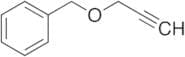
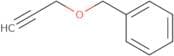
![[(prop-2-yn-1-yloxy)methyl]benzene](/_next/image/?url=https%3A%2Fstatic.cymitquimica.com%2Fcas-image%2Fthumb-webp%2F1230-prop-2-yn-1-yloxy-methyl-benzene.webp&w=3840&q=75)
CAS 4039-82-1
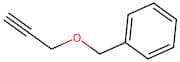
:[(prop-2-yn-1-yloxy)methyl]benzene
Benzyl propargyl ether, 97%
CAS:Benzyl propargyl ether is used in the synthesis of substituted carbocyclic aromatic compounds and pharmaceutical compounds. This Thermo Scientific Chemicals brand product was originally part of the Alfa Aesar product portfolio. Some documentation and label information may refer to the legacy brand.Formula:C10H10OPurity:97%Molecular weight:146.19((Prop-2-yn-1-yloxy)methyl)benzene
CAS:((Prop-2-yn-1-yloxy)methyl)benzene
Purity:95%Molecular weight:146.19g/molRef: 54-OR89640
1gTo inquire5gTo inquire1mlTo inquire50gTo inquire5mlTo inquire25mlTo inquire100mlTo inquire500mlTo inquire[(Prop-2-yn-1-yloxy)methyl]benzene
CAS:Formula:C10H10OPurity:>95.0%(GC)Color and Shape:Colorless to Light yellow to Light orange clear liquidMolecular weight:146.19((Prop-2-yn-1-yloxy)methyl)benzene
CAS:Formula:C10H10OPurity:96%Color and Shape:Liquid, No data available.Molecular weight:146.189Propargyl Benzyl Ether
CAS:Controlled ProductApplications A propargyl derivative used in the synthesis of substituted carbocyclic aromatic compounds and pharmaceutical compounds.
References Takahashi, H. et al.: J. Org. Chem., 74, 3632 (2009); Ding, F. & Jennings, M.: J. Org. Chem., 73, 5965 (2008)Formula:C10H10OColor and Shape:NeatMolecular weight:146.19Propargyl Benzyl Ether
CAS:Propargyl benzyl ether is an organic compound with the formula CHCH=C(CH)OCH. It is a colorless liquid that has been used as a synthetic intermediate in organic synthesis. Propargyl benzyl ether has been shown to induce apoptotic cell death, which may be due to its ability to bind and inhibit the activity of pyrazole-3-carboxamide ribonucleotide transformylase, an enzyme involved in purine metabolism. This compound also induces apoptosis through the activation of caspases. The sample is pretreated before analysis by activating the cells with a solution of HCl and KOH before adding propargyl benzyl ether. Analysis is then conducted using analytical chemistry techniques such as gas chromatography or mass spectrometry. The chemical synthesis can be accomplished by reacting a β-unsaturated ketone with an acid catalyst such as HCl or acetic acid in the presence of a chelate ligand such as pyridine hydro
Formula:C10H10OPurity:Min. 95%Molecular weight:146.19 g/mol
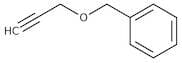

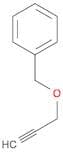


![[(Prop-2-yn-1-yloxy)methyl]benzene](/_next/image/?url=https%3A%2Fstatic.cymitquimica.com%2Fproducts%2F3B%2Fthumb%2FB6421.jpg&w=3840&q=75)