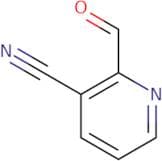
CAS 405174-98-3
:2-Formyl-3-pyridinecarbonitrile
Description:
2-Formyl-3-pyridinecarbonitrile, with the CAS number 405174-98-3, is an organic compound characterized by its pyridine ring structure, which is a six-membered aromatic ring containing one nitrogen atom. This compound features both an aldehyde functional group (formyl) and a nitrile group (carbonitrile) attached to the pyridine ring, contributing to its reactivity and potential applications in organic synthesis. It typically appears as a solid or crystalline substance and may exhibit moderate solubility in polar organic solvents. The presence of the formyl group allows for further functionalization, making it a valuable intermediate in the synthesis of various pharmaceuticals and agrochemicals. Additionally, the nitrile group can participate in nucleophilic reactions, enhancing its utility in chemical transformations. The compound's properties, such as melting point, boiling point, and spectral characteristics, can vary based on purity and environmental conditions. Overall, 2-Formyl-3-pyridinecarbonitrile is of interest in medicinal chemistry and materials science due to its unique structural features and reactivity.
Formula:C7H4N2O
InChI:InChI=1S/C7H4N2O/c8-4-6-2-1-3-9-7(6)5-10/h1-3,5H
InChI key:InChIKey=HEGFDRXMXUROBE-UHFFFAOYSA-N
SMILES:C(#N)C1=C(C=O)N=CC=C1
Synonyms:- 2-Formylnicotinonitrile
- 3-Cyano-2-pyridinecarboxaldehyde
- 3-Pyridinecarbonitrile, 2-formyl-
- 2-Formyl-3-pyridinecarbonitrile
Sort by
Purity (%)
0
100
|
0
|
50
|
90
|
95
|
100
Found 2 products.
3-Pyridinecarbonitrile,2-formyl-(9CI)
CAS:Formula:C7H4N2OPurity:95%Color and Shape:SolidMolecular weight:132.11952-Formylnicotinonitrile
CAS:2-Formylnicotinonitrile is a functional group that has been shown to react with glycosylases, which are enzymes that catalyze the hydrolysis of glycosidic bonds. 2-Formylnicotinonitrile has been shown to inhibit the activity of photosynthetic pigments such as chlorophylls and carotenoids in plants. This compound is able to form a complex with palladium and other transition metals to produce oxidative damage in DNA. It can also be used as a chromatographic method for determining nitrogen atoms in organic compounds or for simulating nmr spectra.Formula:C7H4N2OPurity:Min. 95%Molecular weight:132.12 g/mol