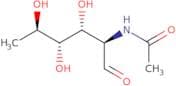
CAS 40614-71-9
:2-(acetylamino)-2,6-dideoxy-D-glucose
Description:
2-(Acetylamino)-2,6-dideoxy-D-glucose, also known as a derivative of D-glucose, is a monosaccharide characterized by the presence of an acetylamino group at the C-2 position and a lack of hydroxyl groups at the C-2 and C-6 positions, which distinguishes it from other glucose derivatives. This compound typically appears as a white to off-white crystalline solid and is soluble in polar solvents such as water and methanol, owing to its hydroxyl groups and polar functional groups. Its molecular structure contributes to its potential biological activity, making it of interest in medicinal chemistry and biochemistry. The acetylamino group can participate in various chemical reactions, including acylation and amidation, which may be relevant for further synthetic applications. Additionally, the compound's properties, such as melting point, boiling point, and reactivity, can vary based on environmental conditions and the presence of other substances. Overall, 2-(acetylamino)-2,6-dideoxy-D-glucose serves as a valuable compound in research and potential therapeutic applications.
Formula:C8H15NO5
InChI:InChI=1/C8H15NO5/c1-4(11)7(13)8(14)6(3-10)9-5(2)12/h3-4,6-8,11,13-14H,1-2H3,(H,9,12)/t4-,6+,7-,8-/m1/s1
Synonyms:- 2-Acetamido-2,6-dideoxy-D-glucose
- D-glucose, 2-(acetylamino)-2,6-dideoxy-
Sort by
Purity (%)
0
100
|
0
|
50
|
90
|
95
|
100
Found 1 products.
N-Acetyl-D-quinovosamine
CAS:N-Acetyl-D-quinovosamine is a chemical compound that belongs to the group of quinovosamines. It is an acidic molecule with a pKa of 3.5 and is soluble in water, methanol, and acetic acid. N-Acetyl-D-quinovosamine has been shown to inhibit the growth of P. aeruginosa strains, which are human pathogens. This drug binds to the bacterial cell wall by competitive inhibition and prevents the formation of an antibiotic-inhibitor complex with the enzyme cell wall synthesis that is required for cell wall biosynthesis, inhibiting protein synthesis and cell division. N-Acetyl-D-quinovosamine also inhibits the production of hydrogen fluoride (HF) by bacteria as well as their ability to produce ammonia from nitrite or nitrate ions.Formula:C8H15NO5Purity:Min. 95%Color and Shape:PowderMolecular weight:205.21 g/mol